In this article
TL;DR
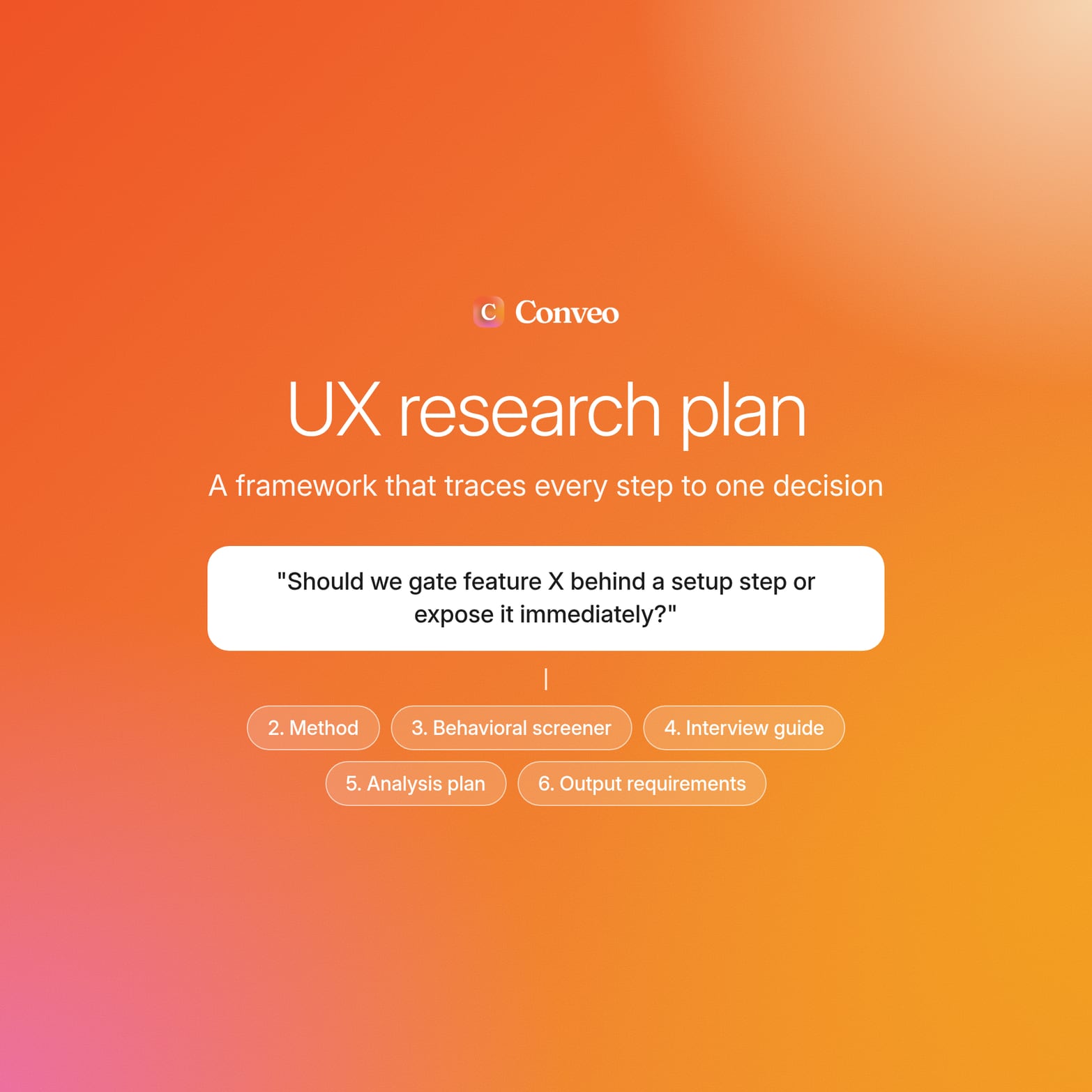
A UX research plan should start with the decision question: the one sentence naming the product decision a study must inform. Five steps follow: method, screener, interview guide, analysis plan, and output requirements.
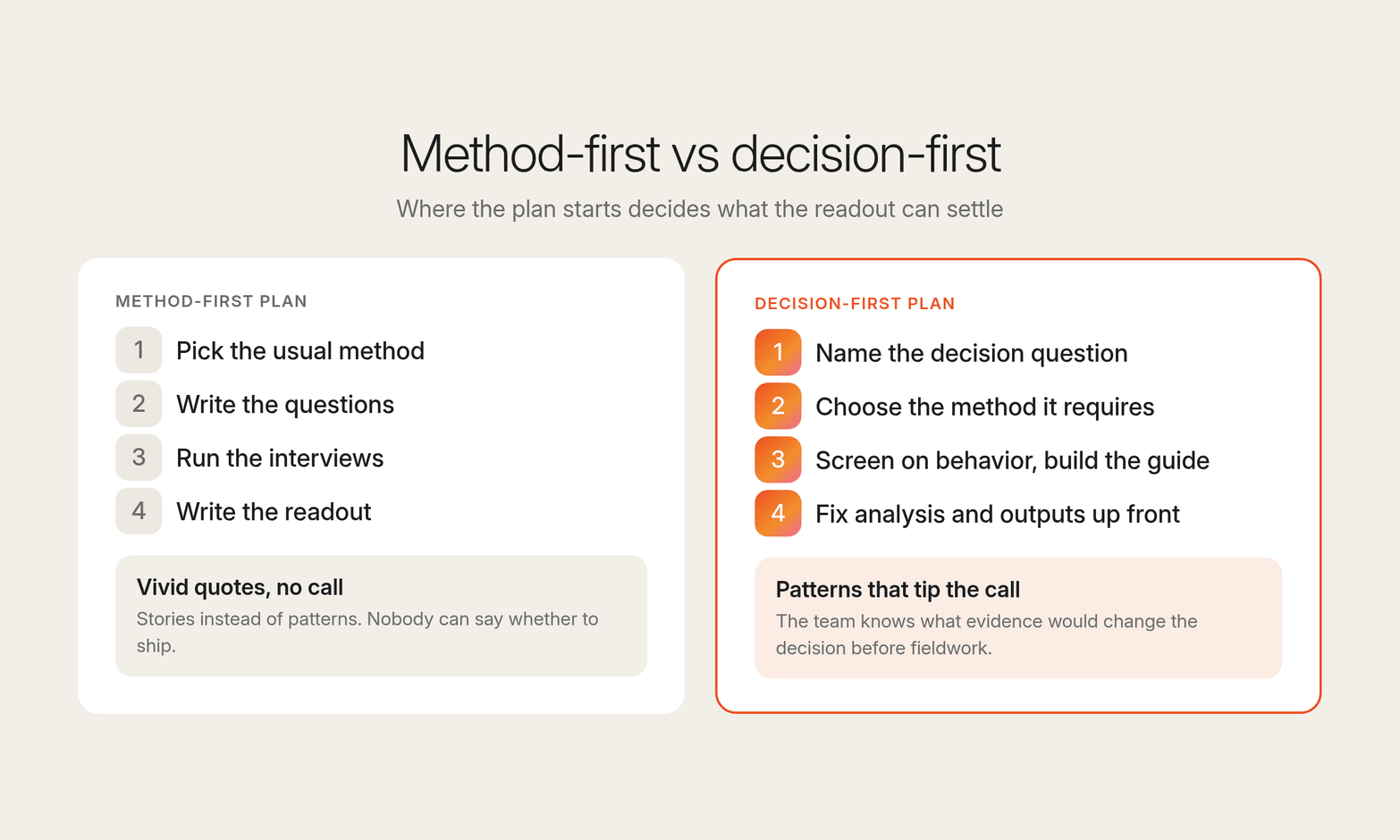
Most UX research plans document a method and skip that decision, so user interviews return stories instead of patterns.
Findings then close the decision they were meant to inform.
A UX research plan sets what a study needs to learn, who to talk to, what to ask, and how to interpret the evidence, all before fieldwork starts. This guide shows how to write one around the product decision it serves, with a six-step framework, three worked examples, and the drafting mistakes that break the link between findings and the call.
Why most UX research plans document a method and skip the decision
A UX team wraps a round of user interviews, and the readout is full of vivid quotes. Nobody can say whether to ship the redesign. Its UX research plan documented a method and never named a decision. Every sprint that ships on a guess instead of a finding is a call the team will revisit later, at higher cost.
In qualitative research, teams often write plans after they pick from their usual UX research methods, such as interviews or usability testing. Objectives, questions, and the decision they serve never connect, so the study answers what the researcher planned to ask while the product question stays open.
Vague research goals like "understand users" or "explore pain points" leave the discussion guide without a research focus. Research sessions drift into open exploration and produce stories that rarely settle a roadmap call or shape UX strategy.
The decision question: the starting point every UX research plan skips
A plan that starts with the decision question gives every later choice something to answer to. The decision question is a single sentence that describes the product decision a study must inform, written in plain language before any method, screener, or discussion guide exists. It plays the role a problem statement plays in the design process. The decision question sits above your qualitative research questions: it names the call, and they name what to ask.
"Understand onboarding friction" invites research participants to tell any story about setup. "Should we gate feature X behind a setup step or expose it immediately?" names a decision. It tells the user researcher who to recruit, which moments to probe, and what pattern would tip the call.
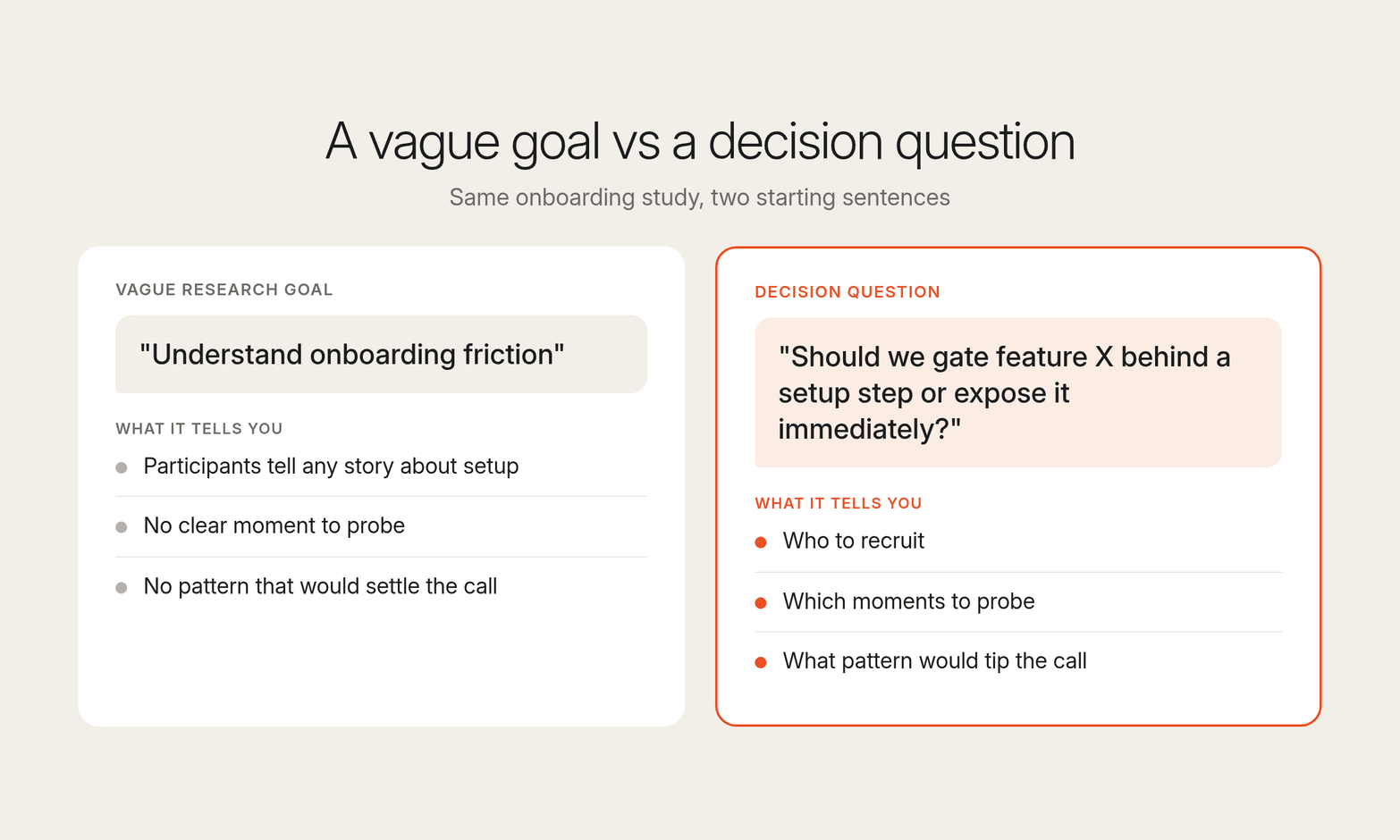
Only the second gives the discussion guide a research focus. That sentence drives the method, participant criteria, analysis plan, and stakeholder-ready reports. That traceability is what separates a good UX research plan from a list of research activities.
A 6-step framework for creating a UX research plan that traces to a decision
Work through this step-by-step guide in order, before the research process moves into fieldwork. Each step builds on the one before it.
Define the decision question. Name the product call, its owner, and an approximate timeline, then put it at the top of the kick-off document. Tie it to the business objectives it serves, so internal stakeholders see why the study exists.
Choose the method the decision requires. Different methods answer different questions, so the research design follows from the call. When choosing between two concepts, compare participants across conditions; for a drop-off question, observe behavior rather than recall.
Write a behavioral screener and sampling strategy. Write screening survey questions on recent behavior and direct experience with the problem, never on age, income, job title, or unsupported persona traits. On Conveo, these become the study's screener questions. Set the sample size based on how many segments the decision has to compare, then recruit participants using the screener.
Build the interview guide from the screened behavior. Keep it semi-structured, with detailed questions about specific past events and adaptive follow-ups that probe hesitation, abandonment, workarounds, and switching triggers. Cut leading questions before the first session begins.
Set the analysis plan against the guide. Fix coding categories, segment tags, and comparison logic; a UX research plan template helps only when every field maps to the decision.
Set output requirements from the analysis plan. Specify the quotes, recordings, and task evidence the readout needs, so fieldwork captures them the first time and the team saves time at synthesis.
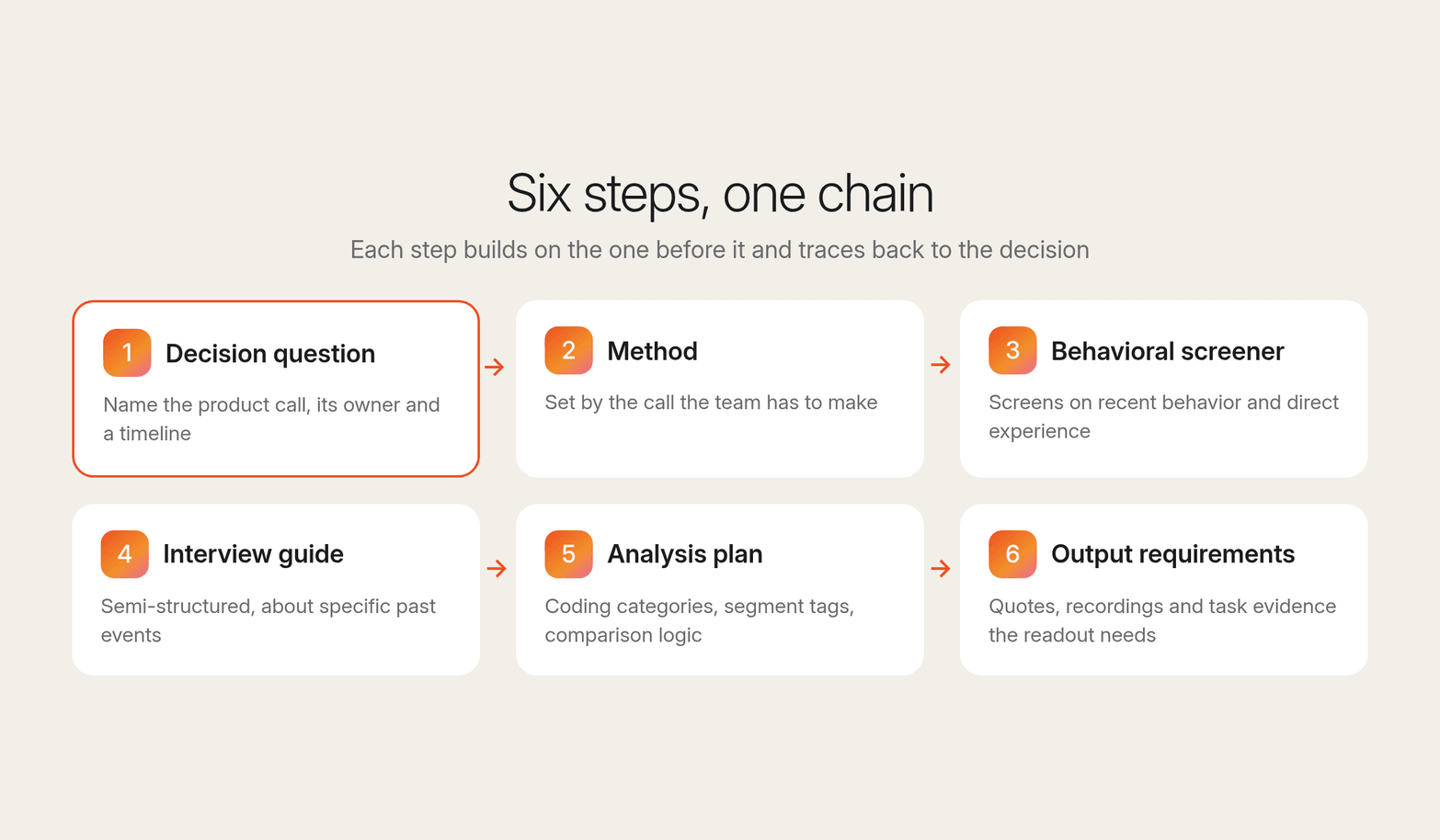
Teams that follow this sequence know what evidence would change the decision before fieldwork starts. Sharing the plan early helps relevant stakeholders agree on that evidence, and that early agreement drives buy-in for the eventual call.
3 calls in a UX research plan that stay with the researcher
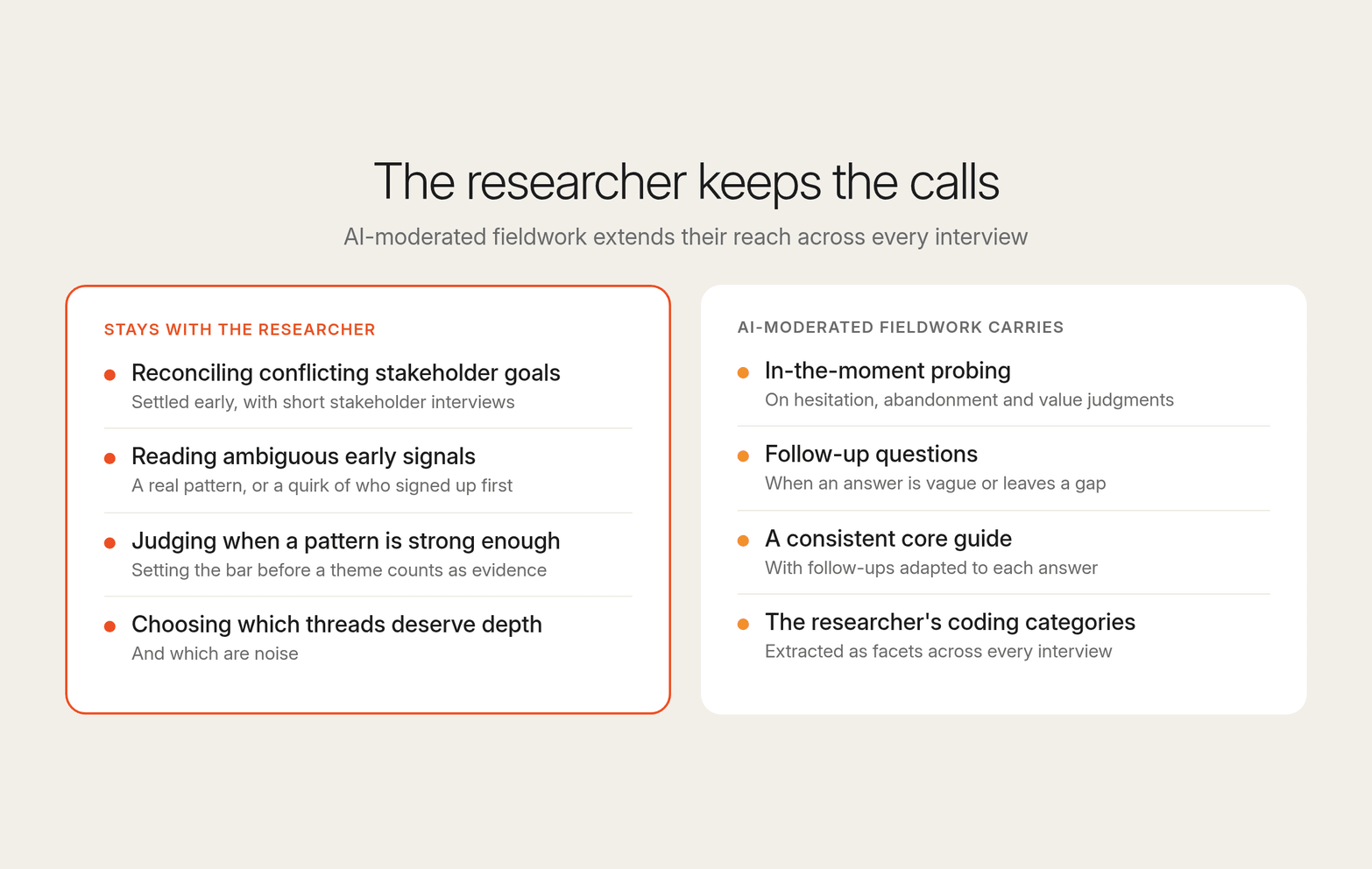
Even with AI-moderated fieldwork, a user research plan keeps these calls with the researcher:
Reconciling conflicting stakeholder goals. This is best settled in the early stages of the research project, with short stakeholder interviews that put everyone on the same page.
Reading ambiguous early signals. A theme from the first few sessions may be a real pattern or a quirk of who signed up first.
Judging when a pattern is strong enough to act on. The researcher sets the bar, such as how many participants and which segments must show the same behavior, before a theme counts as evidence for the decision.
UX researchers get in-the-moment probing on hesitation, abandonment, and value judgments from AI-moderated interviews. Conveo's AI research assistant asks follow-up questions when an answer is vague or leaves a gap, building on what the participant said earlier. The researcher still decides which emerging threads deserve depth in later research sessions and which are noise.
Conveo works as infrastructure that extends that judgment. Its AI research assistant surfaces the evidence, and your team decides what it means.
3 UX research plan examples: discovery, concept testing, and usability
Each worked plan below starts from one decision question and adapts directly to your own UX research study.
| Plan element | Discovery | Concept testing | Usability |
|---|---|---|---|
| Decision question | Rebuild onboarding or extend the trial? | Which of two pricing-page concepts goes to engineering? | Does the redesigned app checkout ship? |
| Method | Semi-structured depth interviews | Concept interviews | Usability testing in task-based sessions |
| Screener | Recent non-converters, split into SMB and enterprise; excludes immediate churners | Recently evaluated a comparable product | Bought through the brand's app in the past month |
| Guide focus | The last session before each participant stopped | Comprehension, relevance, differentiation, objections, and reaction shifts | Dead ends, confusion, and improvised workarounds, captured on video |
| Analysis | Friction by segment, compared against customer feedback | Both concepts coded on the same five dimensions | Task success and failure data paired with video clips |
1. Discovery: rebuild onboarding or extend the trial?
In a representative scenario, a SaaS team runs semi-structured depth interviews with recent non-converters, split into small and midsize business (SMB) and enterprise users. They screen out immediate churners because their behavior reflects an acquisition mismatch rather than product friction. The analysis compares the friction each segment names with existing customer feedback.
2. Concept testing: which pricing-page concept goes to engineering?
In a representative scenario, a product team interviews participants who recently evaluated a comparable product. The guide uses concept testing questions that track how reactions shift after each exposure, instead of binary preference. The team then compares the reasons behind each reaction and which concept better meets user needs.
3. Usability: does the redesigned app checkout ship?
In a representative scenario, a consumer brand's digital team runs usability testing with shoppers who bought through the brand's app in the past month. Before the first interview, the team requires video of every dead end, confusion, or improvised workaround. On Conveo, screen sharing can be turned on for the task questions, so participants share their screen while Conveo observes where they get stuck and probes on the actions it sees. If the new checkout is still in design, the team can attach a clickable Figma prototype to any question in the guide, and participants click through it mid-interview. Analysis pairs quantitative data on task success and failure with those clips, so every usability issue arrives with the moment it happened.
In all three plans, the decision question sets the screener before anyone writes a guide question. Teams that conduct UX research every sprint plan this way because they have no room for a second round of fieldwork.
Canva's research team works at that pace, launching a study straight after a campaign meeting:
"I had a study live by 6:15 p.m., and I had results by first thing in the morning."
Matt Harris, Research & Insights Lead, Canva
5 common UX research plan mistakes that disconnect findings from decisions
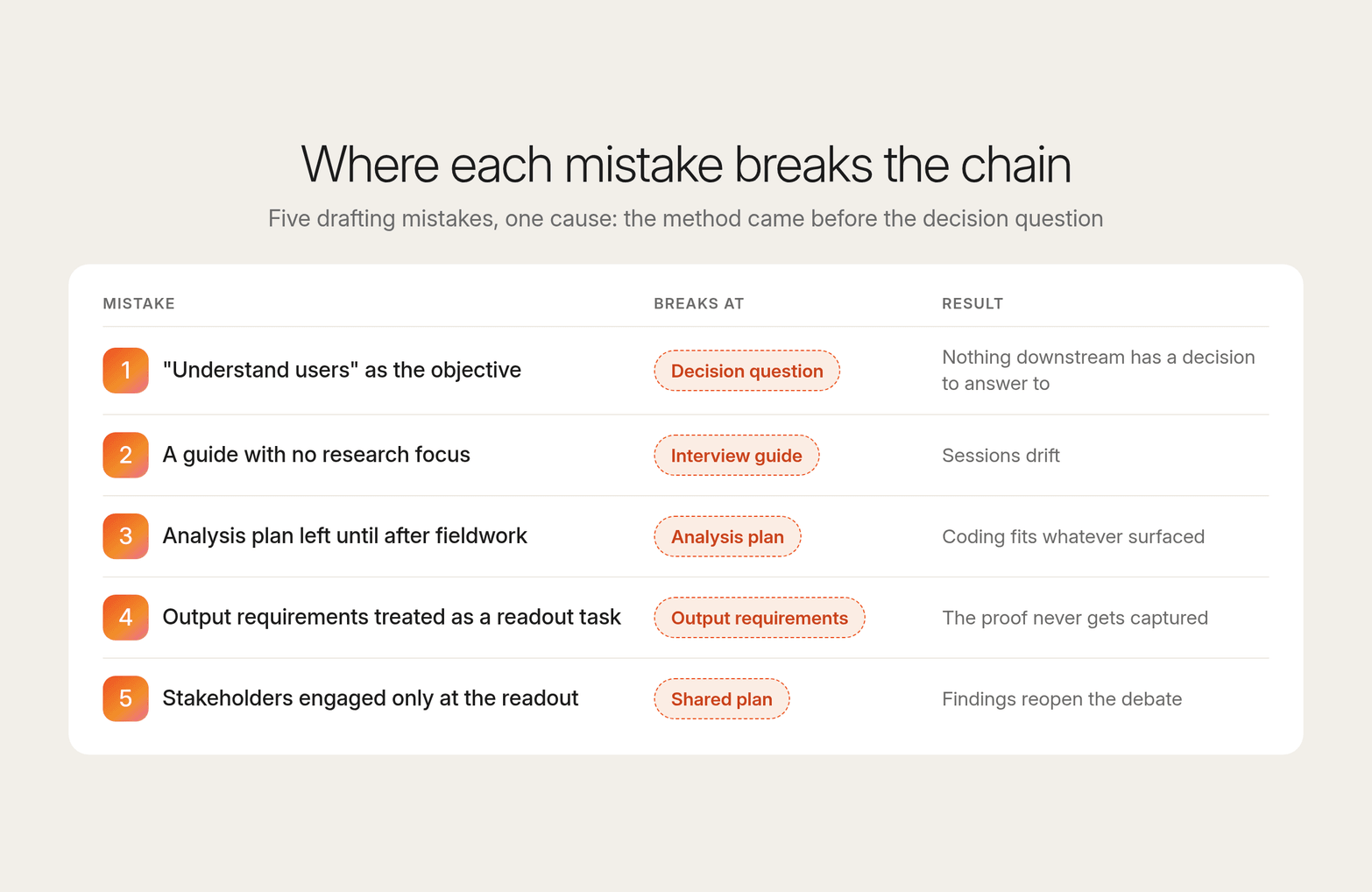
Most of these mistakes happen at drafting, before anyone starts conducting research. They share one cause: teams chose a method before the decision question existed. Experienced research teams catch them during planning, where fixing the plan costs less than rerunning fieldwork.
Writing "understand users" as the objective. Nothing downstream has a decision to answer to.
Drafting the guide without a research focus. Nothing tells the interviewer which pattern to probe toward, so sessions drift.
Leaving the analysis plan until after fieldwork. The coding scheme ends up fitting whatever surfaced in conversation. Decide how you will analyze qualitative research interview data before the first session.
Treating output requirements as a readout task. The quotes and recordings that prove a finding never get captured.
Waiting until the readout to engage stakeholders. The internal stakeholders involved never agreed on the decision, so the findings reopen the debate.
How Conveo keeps every finding traceable to the decision it was meant to inform
Continuous discovery only pays off when every research initiative stays tied to the call it informs. UX teams running a research plan on Conveo keep the six-step chain intact during fieldwork. The decision question shapes the discussion guide and screener questions, and Conveo keeps the core guide consistent across interviews while adapting follow-up questions to each participant's answers. Researchers add their coding categories as facets, and Conveo extracts them across every interview in the study.
Each theme links to the participants behind it, with video clips and verbatim quotes stakeholders can audit. That evidence trail is what turns research findings into actionable insights for a product manager or other key stakeholders.
Recurring themes and facets are recognized across studies in a searchable insight library that serves as the team's UX research repository, so the next study starts from what earlier ones established.
Frequently asked questions
How do I write a UX research plan that starts with the product decision instead of the research method?
Start the UX research plan with the decision question, then let it set the method, sample size, participant criteria, interview guide, and analysis plan. Choosing the method first leaves the research study without a decision to prove. A discussion guide built without that decision collects anecdotes a product team cannot act on.
What should a UX research plan include to connect business goals, research objectives, and interview questions?
A UX research plan connects business objectives to research objectives through one decision question. It specifies the discussion guide, coding categories, comparison logic, and required evidence.
How can I tell whether a research question will produce evidence a product team can actually act on?
A research question is actionable when it maps to a named decision and yields patterns across research participants rather than anecdotes. Otherwise, revise the research plan.
How can AI help with a UX research plan?
AI helps most with fieldwork and analysis. An AI research assistant can run AI-moderated interviews, ask follow-up questions when an answer is vague, and extract the researcher's coding categories across every interview. The researcher still writes the decision question and decides what the evidence means.
Are there UX research plan templates that trace each interview question back to an objective and product decision?
Yes, but templates work only when each of your [user interview questions](/insights/user-interview-questions) is tagged to a decision question and analysis plan. A research plan helps most as a one-page cheat sheet of six steps: decision question, method, behavioral screener, interview guide, analysis plan, and output requirements, with every field mapped to the decision.

About the author
Alex de Hemptinne
Business Impact Lead
Alex is a Business Impact Lead at Conveo, partnering with enterprise teams to embed AI-led research into their workflows. From the first study to full-scale rollout, she helps customers shift from project-based research to continuous customer intelligence.
Meet Alex on film →Qualitative insights at the speed of your business.
Conveo runs AI-moderated video interviews and structures everything they say.