In this article
TL;DR
Technology market research explains why buyers choose, adopt, or abandon a technology product. Usage dashboards and analyst reports show what customers do, but never why they chose a competitor, so insights arrive after the roadmap or positioning decision is locked in.
This technology market research framework pairs usage data with customer interviews run alongside each release cycle, so the explanation arrives while the decision is still open.
Applying the framework gives tech businesses evidence to make informed decisions about the roadmap and market positioning.
Tech teams have never had more usage data, yet the reasons customers buy, stall, or switch rarely reach the roadmap. This guide covers what technology market research adds to analytics, a seven-step framework for interviewing customers each release, and the mistakes that undo it at speed.
Why usage data and analyst reports miss the why
A product team ships a roadmap built on usage dashboards and analyst reports on industry trends, and nobody can explain why subscribers keep leaving for a competitor's app. Most technology market research stops there: teams know what users do and how big the market is, but not why customers choose one product over another.
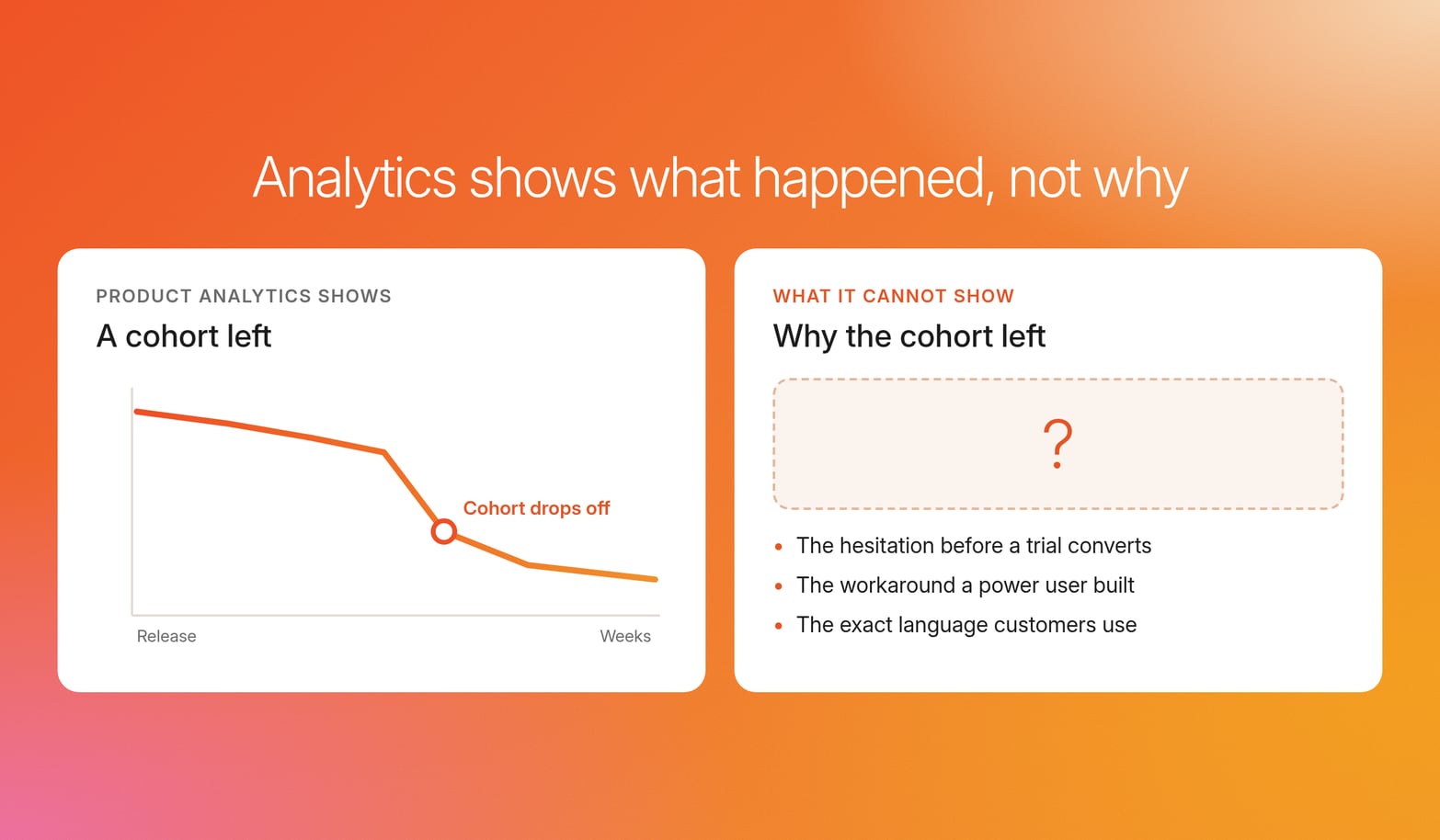
Roadmaps and positioning get built across that gap:
A differentiator gets claimed that users never mention, while the competitor strategies that win them over go unexamined.
A feature gets prioritized for a segment that never adopts it.
A churn spike gets explained after the quarter closes, once subscription business models have absorbed the loss.
Product managers trying to stay ahead reach for a survey or focus groups next. The limitations of quantitative research show up here: a survey quantifies customer preferences but misses what explains consumer behavior:
The hesitation before a trial converts.
The contradiction between what a user says they value and what they pay for.
The workaround a power user built because the feature did not fit.
The exact language customers use for their pain points.
Marketing teams then turn to personas, the starting point of most marketing strategies. Traits like "tech-savvy" describe who target audiences are but fail stakeholder scrutiny the moment a product leader asks which interview, quote, or recording supports them. In the tech world, these personas age quickly as products and habits change, and every decision built on them, from roadmap to business strategy, rests on behavior without the reasoning behind it.
What technology market research means beyond analytics and analyst reports
Technology market research studies why buyers and users choose, adopt, resist, or abandon a technology product, captured in their own words. It supplies what product analytics and analyst reports cannot: user-stated reasoning that turns a usage curve into an explanation teams can act on.
| Source | What it shows | What it cannot show |
|---|---|---|
| Product analytics | Behavior, such as a retention chart showing that a cohort left | Why the cohort left |
| Analyst and industry reports | Market size, market forecasts, and the market trends behind category growth, drawn from secondary research | Why a specific customer chose a competitor |
| Technology market research | Customer-stated reasons buyers choose, adopt, resist, or abandon a product | How broadly those reasons hold, which quantitative research then sizes |
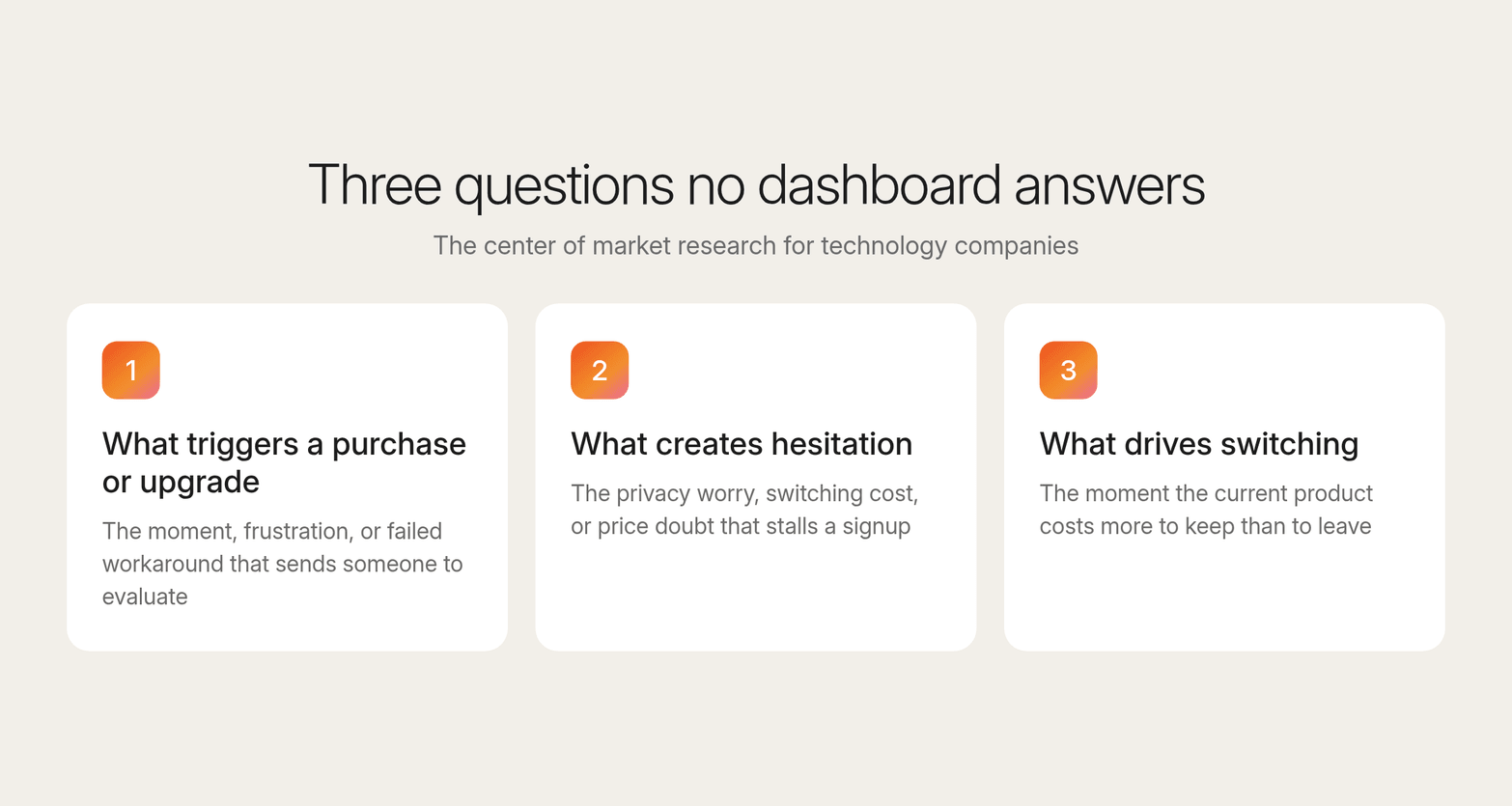
Three questions sit at the center of market research for technology companies, and no dashboard answers them:
What triggers a purchase or upgrade: the moment, frustration, or failed workaround that sends someone to evaluate technology solutions.
What creates hesitation: the privacy worry, switching cost, or price doubt that stalls a signup, especially for emerging technologies with no benchmark.
What drives switching: the moment the current product costs more to keep than to leave.
Qualitative interviews explain the language and emotional drivers behind a decision, and quantitative research, from surveys to advanced analytics, validates how broadly those patterns hold, the core of mixed methods research. Conveo asks the rating or choice question and follows up on the reason in the same video conversation, so the count and the reason come from the same participant.
A framework for pairing usage data with customer interviews each release
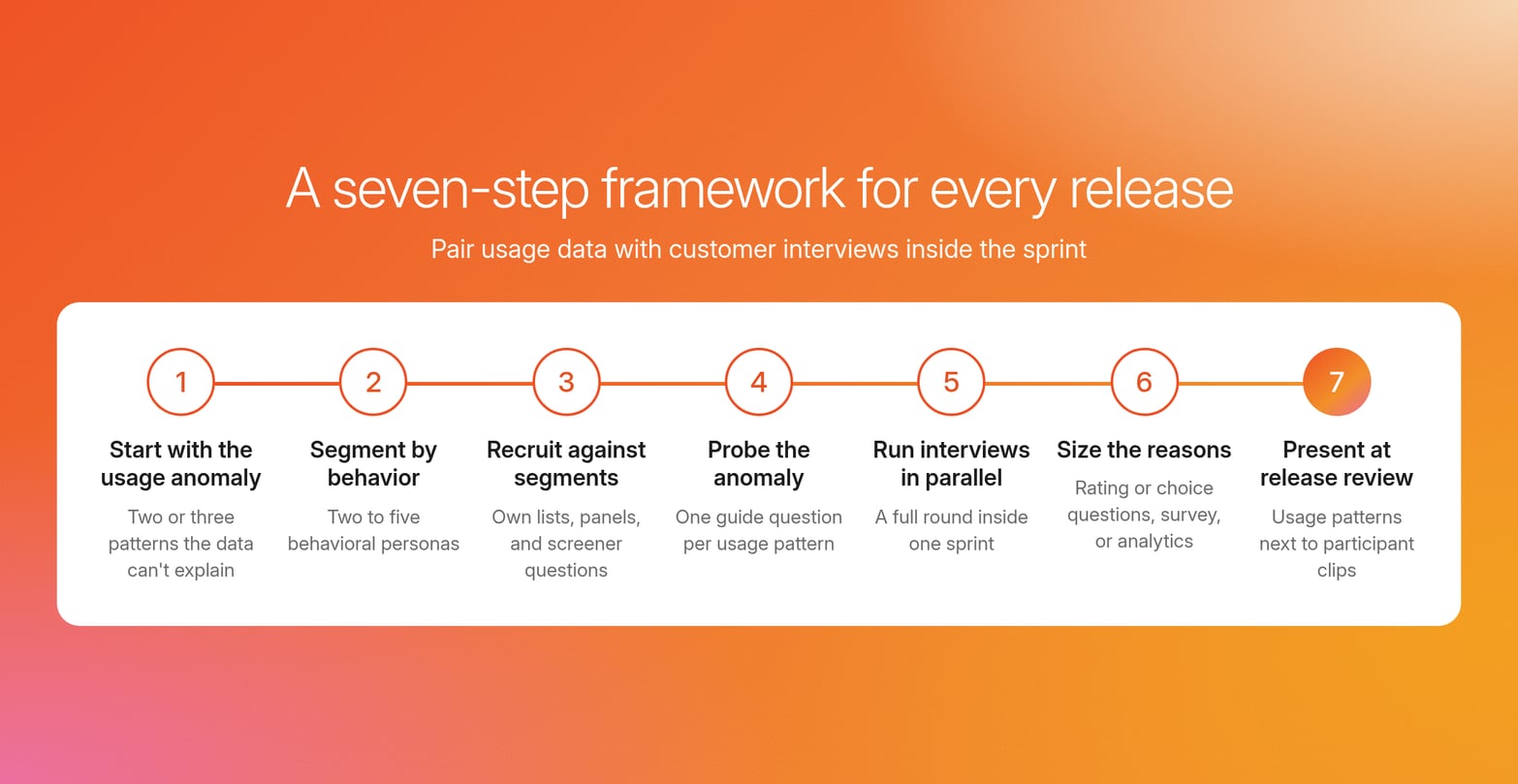
This repeatable technology market research framework treats market research as part of shipping, built into every release's sprint calendar. The output is a release review where every unexplained number has participants explaining it.
Start with the usage anomaly. Before each release review, pull the two or three patterns your data analytics can't explain, prioritizing those tied to this quarter's business objectives, such as high trial with low repeat use or a segment churning faster than its cohort.
Segment by behavior before recruiting. Let usage data define who you interview, so market segmentation ties every interview to a data pattern. Most products need two to five behavioral personas and five to 15 participants per segment.
Recruit against those segments. To recruit users for user research that matches the pattern, pull current customers from your own lists and prospects, or competitor users through integrated panel partners, and use screener questions to confirm each participant fits.
Write questions that probe the anomaly. Map each discussion guide question to one usage pattern. Ask participants to walk through the last time they used, skipped, or worked around the feature, then probe the hesitation and customer pain points behind it.
Run interviews in parallel inside the sprint. Run AI-moderated video interviews simultaneously, so companies can field a full round in one sprint and get findings while the release decision is still open.
Size the reasons with quantitative data. Add rating or choice questions to the same conversation, or test how broadly themes hold with a short survey or a cut of product analytics, so the consumer data shows how far each pattern extends.
Present both at release review. Show each usage pattern next to the participant clips that explain it, so roadmap calls rest on evidence stakeholders can replay.
"I don't think it's the case anymore that doing research has to be this big investment in time and money — mainly time — this chore that slows everything down. I think it can be a resource that you can just, and should just, tap into constantly and frequently as you're making decisions."
Matt Harris, Research & Insights Lead, Canva
Where researcher judgment still drives technology market research
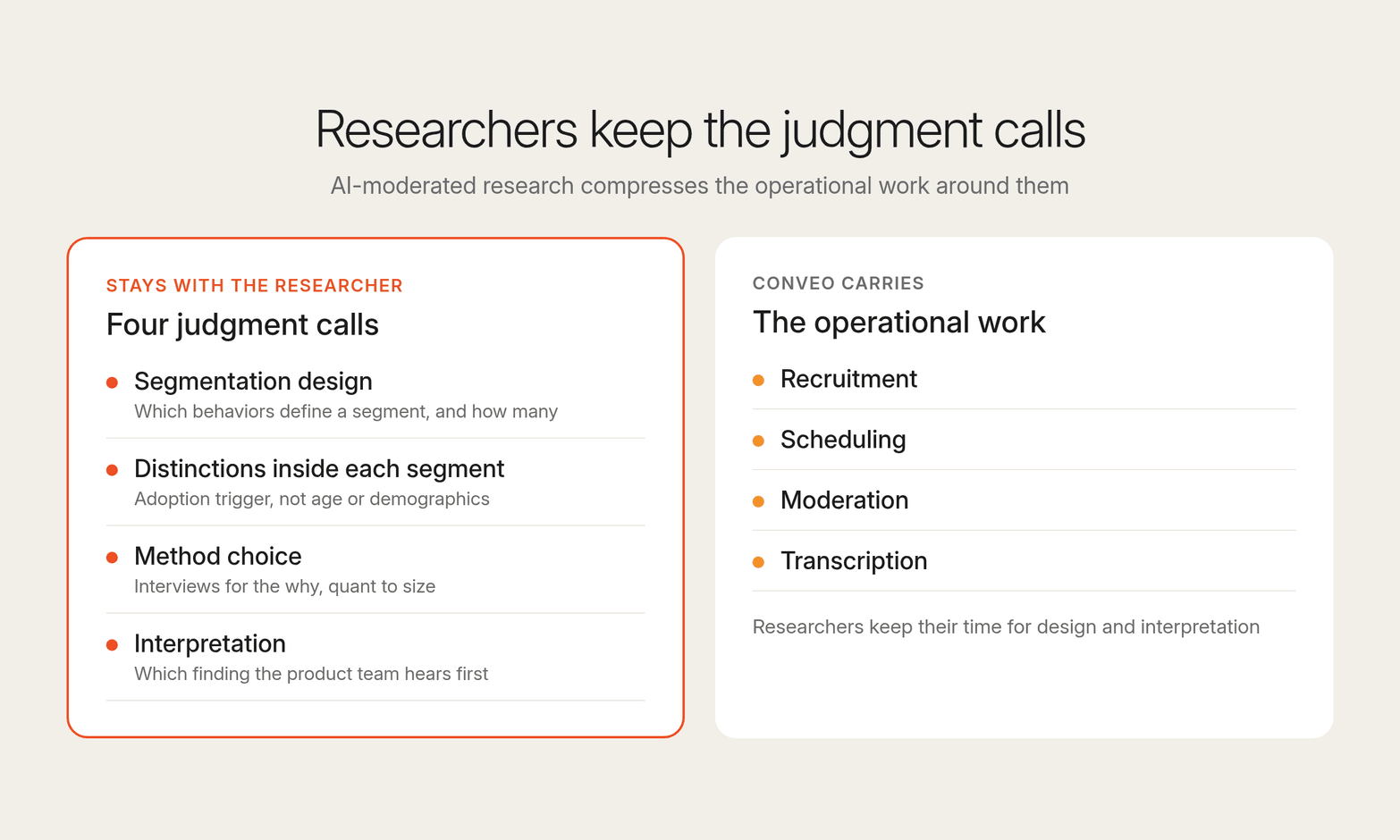
AI-moderated research compresses the operational work of technology market research: recruitment, scheduling, moderation, and transcription.
Four calls stay with the researcher in any technology research program:
Segmentation design. Choosing which behaviors define a segment, and how many, shapes every finding downstream. A poor cut produces clean-looking themes that describe nobody.
Distinctions inside each segment. Users who look identical in usage data need separating by adoption trigger rather than age or demographics:
Privacy-cautious users stall at the permissions screen, while generally cautious users stall waiting for proof from friends or reviews.
Solo power users adopt to solve their own problem, while group adopters join because a friend, partner, or teammate brought them in.
Method choice. Each release cycle, a researcher decides which questions need interviews to understand the why and which need only quantitative research to size.
Interpretation. When participants name price as the blocker but describe onboarding friction for 10 minutes, a researcher decides which one the product team hears first.
With Conveo carrying recruitment, scheduling, moderation, and transcription, researchers keep their time for design and interpretation.
Technology market research in practice: three release-cycle scenarios
The three scenarios below show technology market research running alongside a technology industry release cycle. They are illustrative rather than drawn from a named customer. For a named example, see how Canva brings the consumer voice into every decision.
Scenario one: a feature adoption drop that dashboards could not explain
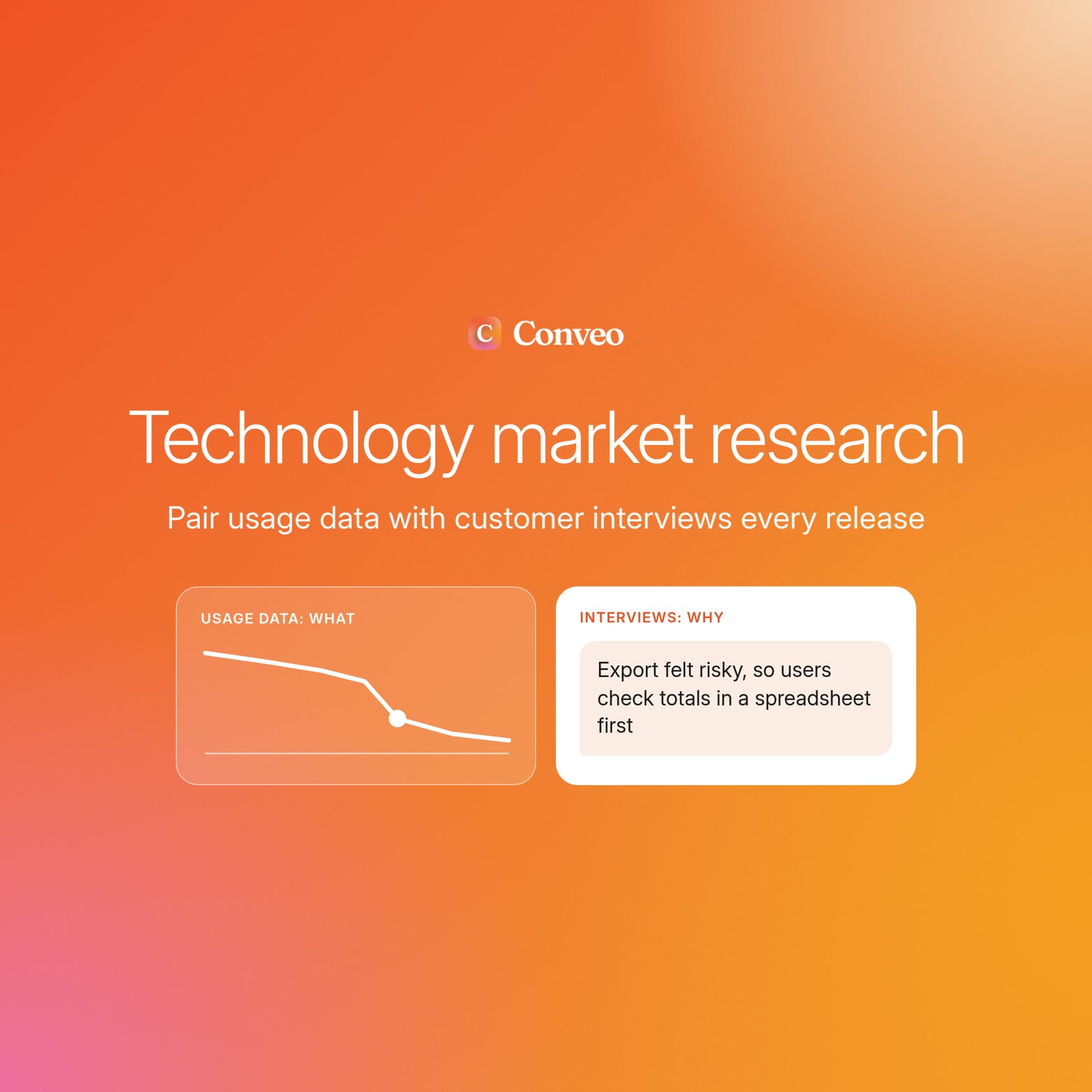
The gap. A software team ships a redesigned reporting feature. Two weeks later, trial usage holds but repeat usage drops after one session, and a follow-up survey records "not useful" without saying why.
The interview round. The insights lead interviews 12 users who tried the feature once and stopped, with screen sharing switched on for the questions about the export flow. When one says the export "felt risky," the AI research assistant follows that wording and asks what risky means. Several participants show the same workaround on screen: exporting to a spreadsheet to check totals before sharing.
The outcome. On video, one participant pauses before admitting they don't trust the numbers, and another brightens as they describe a competitor's export preview. Product development ships a validation view in the next sprint.
Scenario two: a positioning deck built on a stale persona
The gap. A product marketing team at a creator platform is finalizing market positioning for a new subscription tier. The deck rests on a workshop persona, a tech-savvy creator who wants pro tools, and when the CMO asks which creator said that, nobody has a recording.
The interview round. Costs and timelines from outside research companies had kept the persona untouched while the market landscape changed. This time, the team interviews recent upgraders and recent cancellations the week before launch messaging locks. Creators describe themselves as short on time; nobody says tech-savvy, and the upgrade trigger turns out to be a brand-deal deadline.
The outcome. Each theme links to the participants behind it, with video clips and verbatim quotes stakeholders can audit, so the CMO watches three creators say it themselves. The positioning shifts to hitting deadlines, and stakeholders sign off on marketing efforts built on evidence they checked.
Scenario three: a multi-market launch where local fieldwork could not keep pace
The gap. A consumer app launching in four tech markets, the US, Germany, Japan, and Brazil, needs qualitative research at scale to decide where to launch a new premium tier first. German and Japanese trials convert well below the US rate, and local market research firms, translators, and sequential fieldwork could add eight to 12 weeks with launch six weeks out.
The interview round. The consumer insights team runs AI-moderated interviews in all four markets the same week, with interviews in 50+ languages and automated transcription and translation letting synthesis start while interviews run. Price testing inside the interview (Van Westendorp or Gabor-Granger, currently in research preview) returns the acceptable price and the reasons behind it from the same participants.
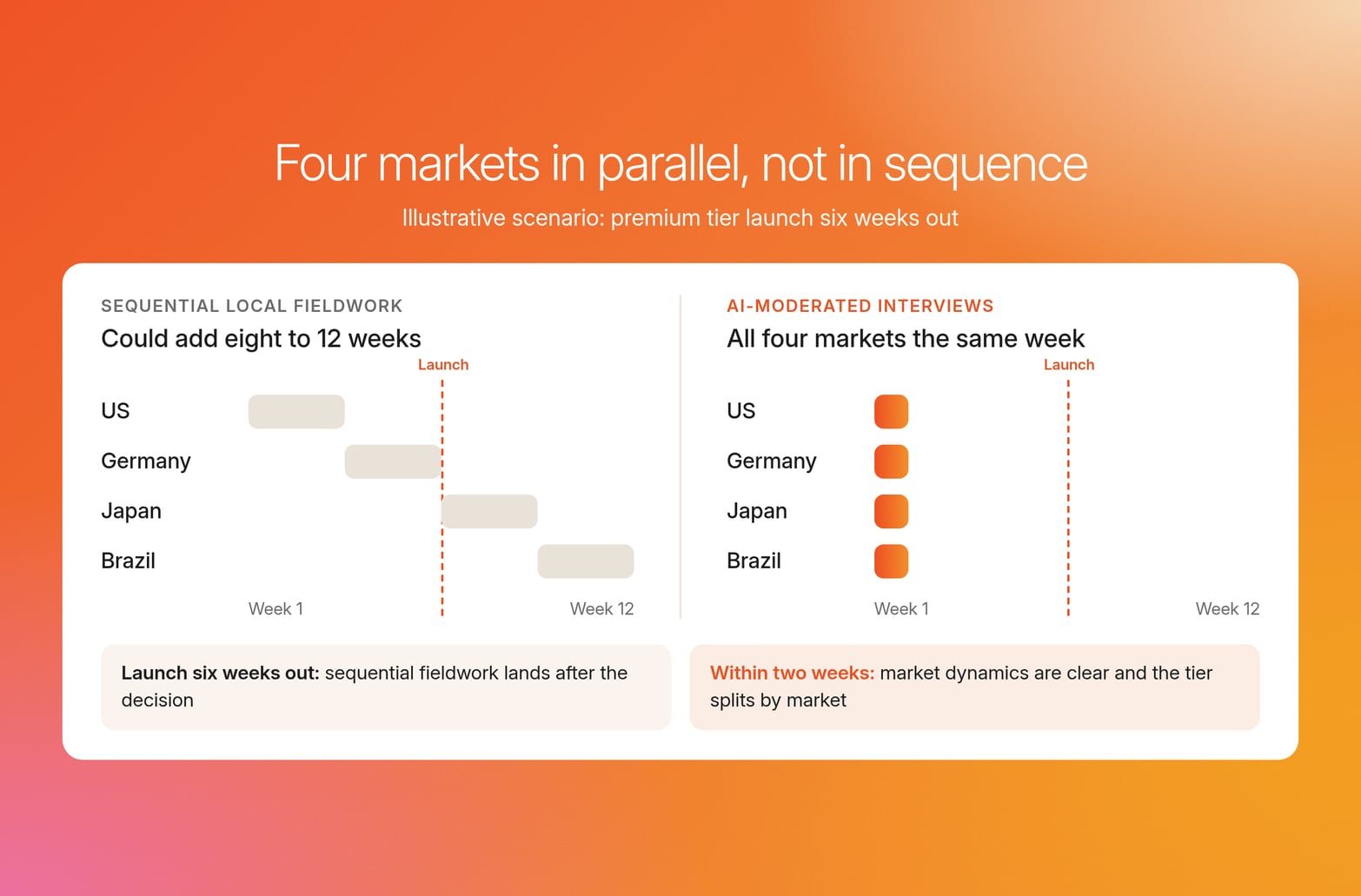
The outcome. Within two weeks, the market dynamics are clear: German participants want clearer privacy terms before paying, and Japanese participants expect a lower entry price. The team splits its pricing strategies by market, holding the tier in Germany and Japan and launching in the US and Brazil.
4 common mistakes when running technology market research at speed
Across the tech industry, teams compress technology market research timelines without changing method, and a faster version of the old process still can't explain why customers chose a competitor.
1. Treating personas as finished artifacts. A team runs one fast study, refreshes the persona, and locks it in a slide, so it still describes who the user is without explaining what triggers a purchase, hesitation, or a switch.
The fix: Rebuild personas around those triggers and the customer expectations behind them, with a clip or quote behind every trait.
2. Letting findings expire between studies. When a technology market research company commissions every study separately, cost and timelines make continuous updates impractical, and positioning decks drift out of date as the market keeps moving.
The fix: Run short interview rounds on the release cadence and keep any agency as a strategic research partner for foundational work.
3. Compressing one market and sequencing the rest. A faster home-market study does little if other markets still run through local agencies in sequence.
The fix: Field every market in parallel and start synthesis while interviews run.
4. Recruiting for speed instead of fit. Under deadline, teams drop the screener questions and interview whoever is available, so the themes describe people outside the usage pattern.
The fix: Keep the screening survey questions and shorten the guide instead.
Why Conveo closes the gap between usage data and consumer reasons
Technology market research now runs alongside usage analytics, and 400+ enterprises, including Google, AB InBev, and Canva, rely on Conveo to keep consumer reasoning this close to the roadmap.
In Conveo, each theme links to the participants behind it, with video clips and verbatim quotes stakeholders can audit, so product leaders verify the why behind the usage numbers themselves.
Studies recognize recurring themes and facets in a searchable insight library, so the next wave builds on what earlier ones established instead of starting with a blank codebook. Conveo StoryLines runs the same wave-based interviewing on a fixed cadence, for example every two weeks or monthly, helping teams identify emerging opportunities between studies.
A product manager flags an activation drop on Monday, and the insights lead launches interviews that afternoon with stalled consumers, so the findings arrive while the roadmap decision is still open.
Frequently asked questions
How is technology market research different from product analytics and analyst reports?
Technology market research explains why customers choose one product over another, while data analytics and industry reports show behavior, market size, and market forecasts. Interviews supply the reasons, and quantitative data confirms how broadly they hold.
Which research methods best explain why customers choose one technology product over another?
Adaptive, AI-moderated interviews explain choice best, surfacing the hesitation, contradictions, and workarounds that surveys, focus groups, and demographic personas miss. In technology market research, surveys quantify customer preferences but cannot follow an unexpected answer. The AI research assistant follows each participant's wording to the reason behind a reaction, and video keeps the tone and pauses transcripts lose.
What should we look for in a technology market research platform if we need answers in days rather than weeks?
Whether you evaluate [AI market research tools](/insights/ai-market-research-tools) or a technology market research company, look for three capabilities: parallel interviewing that can complete 100 interviews in 3 days, themes linked to the participants behind them with video clips and verbatim quotes stakeholders can audit, and interviews in 50+ languages, recruited through 8 integrated panel partners plus your own lists.
How do we connect customer interviews with product usage data to improve roadmap and positioning decisions?
Interview the participants behind each unexplained usage pattern in the same release cycle. Segment by behavior first: most products need two to five personas and five to 15 participants per segment. Then recognize recurring themes across studies in a searchable insight library, so each technology market research wave starts from what earlier ones established.
How can a small research team expand its research capacity?
A small research team expands capacity by running AI-moderated interviews in parallel, so one researcher can conduct technology market research every release without commissioning a top market research company for each question. Traditional qualitative work stalls because recruitment, scheduling, moderation, transcription, and analysis each wait on the step before.

About the author
Hendrik Van Hove
Founder & CPO
Hendrik is Conveo’s Chief Product Officer and co-founder. He's extremely passionate about technology and the real positive impact it can bring. Before Conveo, he ran AI strategy projects at McKinsey for the Fortune 2000, working with boards and every function from marketing, to sales to insights.
More by Hendrik →Qualitative insights at the speed of your business.
Conveo runs AI-moderated video interviews and structures everything they say.