In this article
TL;DR
Market segmentation research divides a market into groups teams can target, yet segments built from survey clusters and named after the fact often go unrecognized by brand and commercial teams, and the deck goes stale.
This five-step framework builds needs-based customer segments from real conversations, with segmentation criteria set first.
Commercial teams get actionable segments, traceable to real participants instead of workshop guesswork.
Market segmentation research is supposed to tell brand, marketing, and sales teams who to target and why. Too often it hands them named personas they can't match to a single real shopper, and the decisions those segments were meant to shape go ahead without them. This guide explains why survey-cluster segments break down, what needs-based segmentation does differently, and how to build segments from real customer conversations in five steps.
When the segmentation decision ships before the insight does
A brand manager opens the deck from last quarter's segmentation study, finds "Pragmatic Paula" on slide 14, and asks which real shopper is a Paula. Nobody can answer. By the time anyone could, pricing and marketing messages had already been set against a buyer who doesn't exist. That's the real cost: the insight arrives after the business decisions it was meant to inform have already closed, so it might as well never have happened.
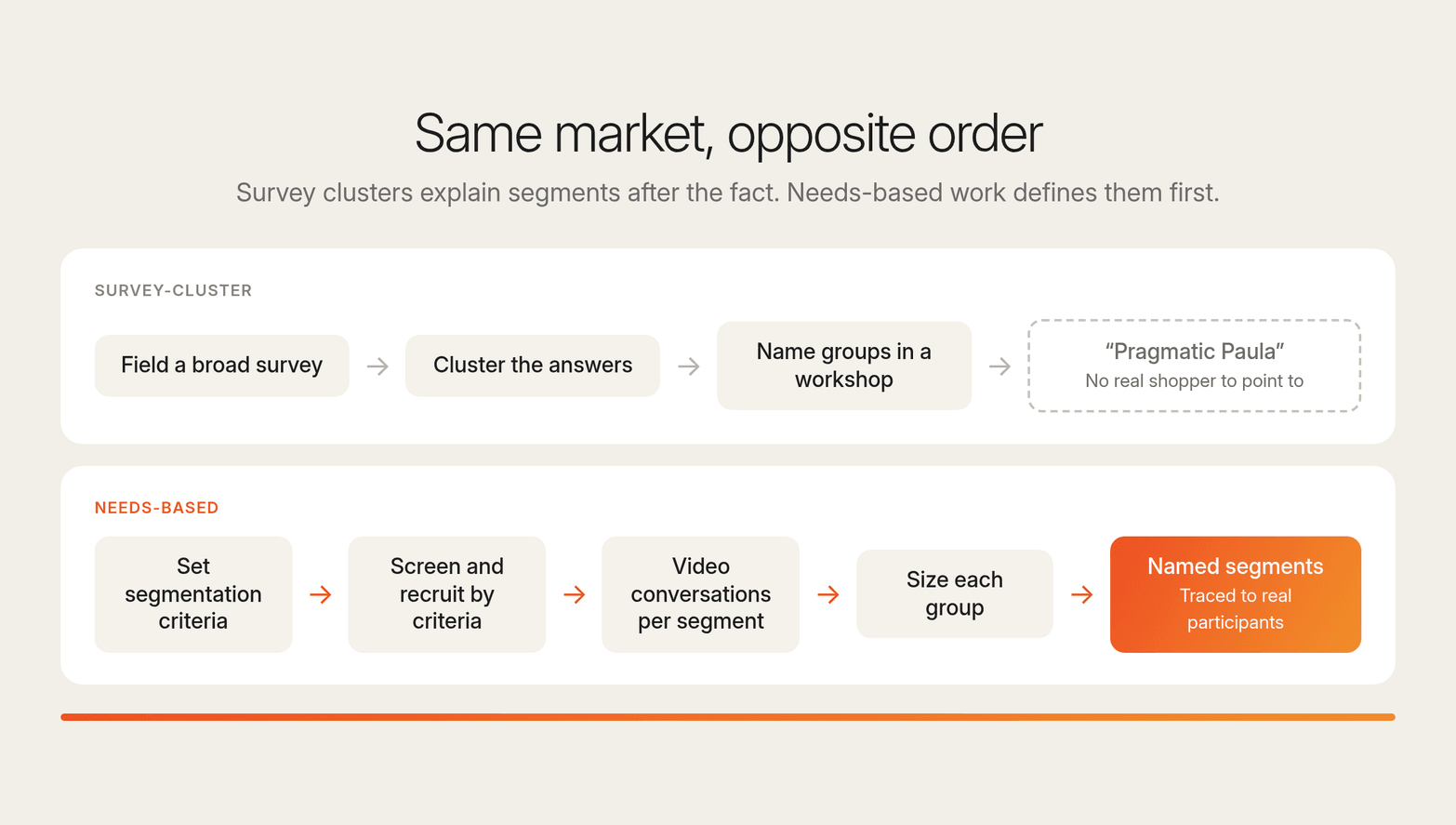
The usual market segmentation process recruits a broad sample, fields a survey, runs data analysis to cluster the answers, and names the groups afterward. Clustering the entire market at once averages across the differences that decide purchases, such as price sensitivity, purchase triggers, and switching moments, one of the core limitations of quantitative research. The resulting profile describes no actual buyer in the target market.
Then the labels come from a workshop or a round of focus groups. When a product lead asks why a segment is called "Cautious Innovators," the team can point to a score but not a participant. The debate becomes an opinion contest.
Meanwhile, the profile ages. Customer needs and market trends can shift within months, yet agency costs and timelines limit most market research programs to a few foundational studies. The deck keeps circulating long after it stopped describing anyone, and every roadmap, pricing, or marketing campaign decision made against it closes a little further behind what buyers actually need.
What needs-based segmentation means and when to use it
Needs-based segmentation is an approach to market segmentation research that groups current and potential customers by the problem they are trying to solve and how they decide, with behavioral criteria set before anyone is recruited.
Demographic data tells you a buyer is an operations manager at a 500-person firm, and firmographic segmentation adds industry and revenue band. Neither tells you why that buyer chose, hesitated, switched, or built a spreadsheet workaround instead of buying. Survey-cluster segmentation finds customer segments statistically first and explains them second, which is how the differences that drive purchase behavior get blended out.
Here's how the three approaches compare:
| Approach | How groups are formed | What it tells you | Where it falls short |
|---|---|---|---|
| Demographic and firmographic | By who the buyer is: role, company size, industry | Who buys | Says little about why buyers choose, hesitate, or switch |
| Survey-cluster | Statistical clustering first, labels added afterward | Which groups differ statistically | Averages away the differences that decide deals; labels rarely trace to a real buyer |
| Needs-based | Behavioral criteria (triggers, risks, decision logic) set before recruitment | Why buyers choose and how they decide | Researchers still judge which differences define a segment boundary |
Use needs-based segmentation when segments have to change what sales says, what product builds, or where marketing efforts go. Teams that properly segment by need can point marketing channels at the target audience most likely to convert, which focuses spend where it does the most work.
Needs-based segmentation pairs two kinds of evidence, a form of mixed methods research:
Quantitative work sizes and identifies each group.
Qualitative research explains the consumer motivations and decision logic that make each group actionable.
The strongest version gets both from the same participants, so the number and the reason never need reconciling later.
A five-step framework for segments commercial teams can recognize
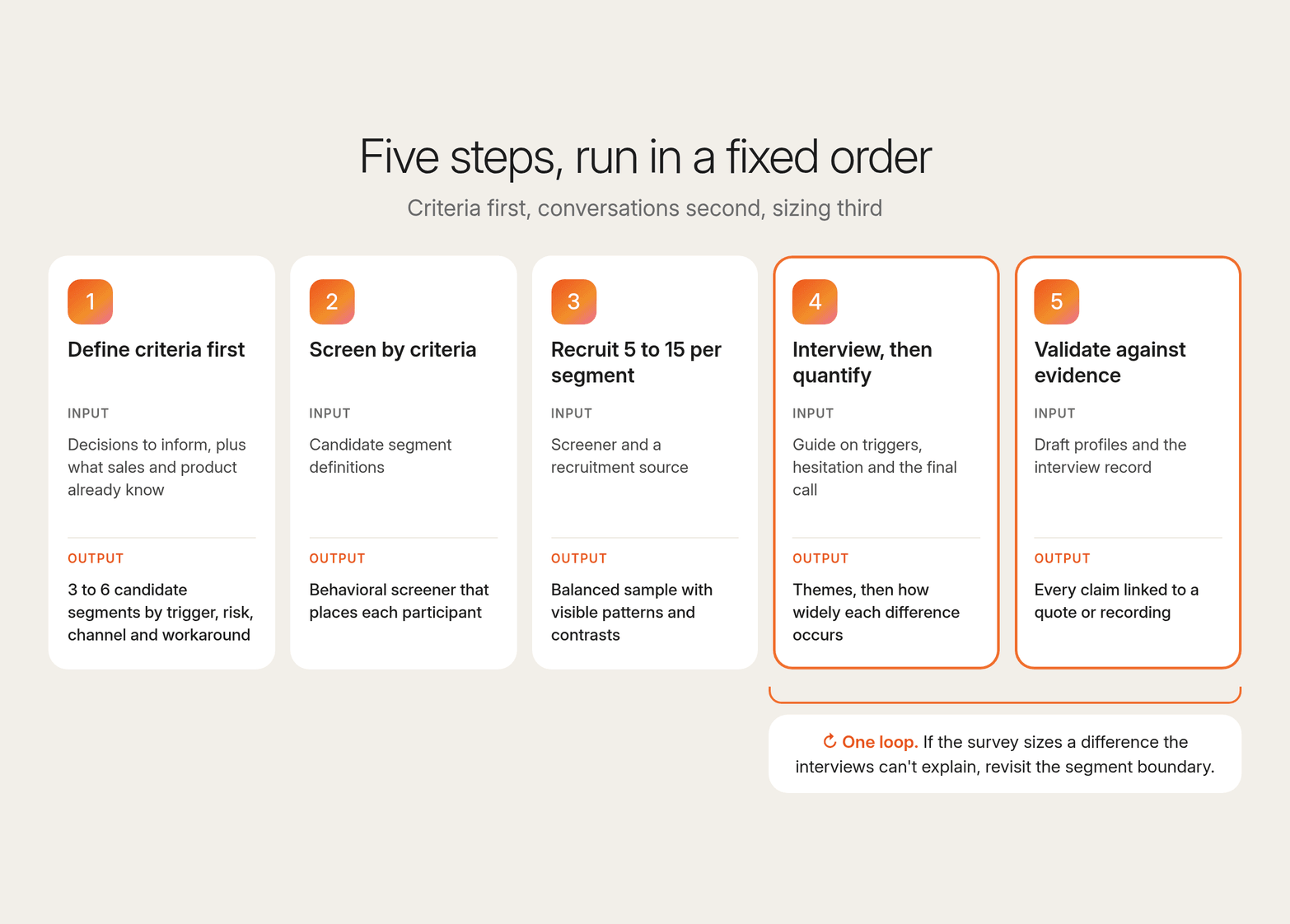
Market segmentation research holds up commercially when it runs in a fixed order: criteria first, conversations second, sizing third. Sequence matters more than any single technique, because clustering first and explaining later is what produces segments nobody can find.
Define segmentation criteria before recruitment.
Input: The business decisions the segmentation must inform, plus what sales, product, and secondary research already show.
Output: Three to six candidate segments defined by purchase triggers, perceived risks, channels such as digital platforms or field sales, evaluation style, and current workarounds.
Write a screener that sorts by those criteria.
Input: The candidate segment definitions.
Output: Behavioral screening survey questions that place each participant in one of the specific segments before any interview starts.
Recruit five to 15 participants per segment.
Input: The screener and a recruitment source.
Output: A balanced sample where, in practice, recurring patterns within each segment and contrasts across different segments become visible.
Run in-depth interviews, then quantify.
Input: A discussion guide probing triggers, hesitation, and how the final call gets made.
Output: Themes explaining why segments differ, followed by a survey, perceptual map, or behavioral data showing how widely each difference occurs.
Validate every segment against participant evidence.
Input: Draft segment profiles and the interview record.
Output: Profiles in which each claim links to a verbatim quote or recording, reviewed with sales and product before any segment gets a name.
Treat steps 4 and 5 as one loop in the research process. If a survey sizes a difference the interviews can't explain, the segment boundary needs another look before it reaches a sales team.
Where human judgment still decides what a segment means
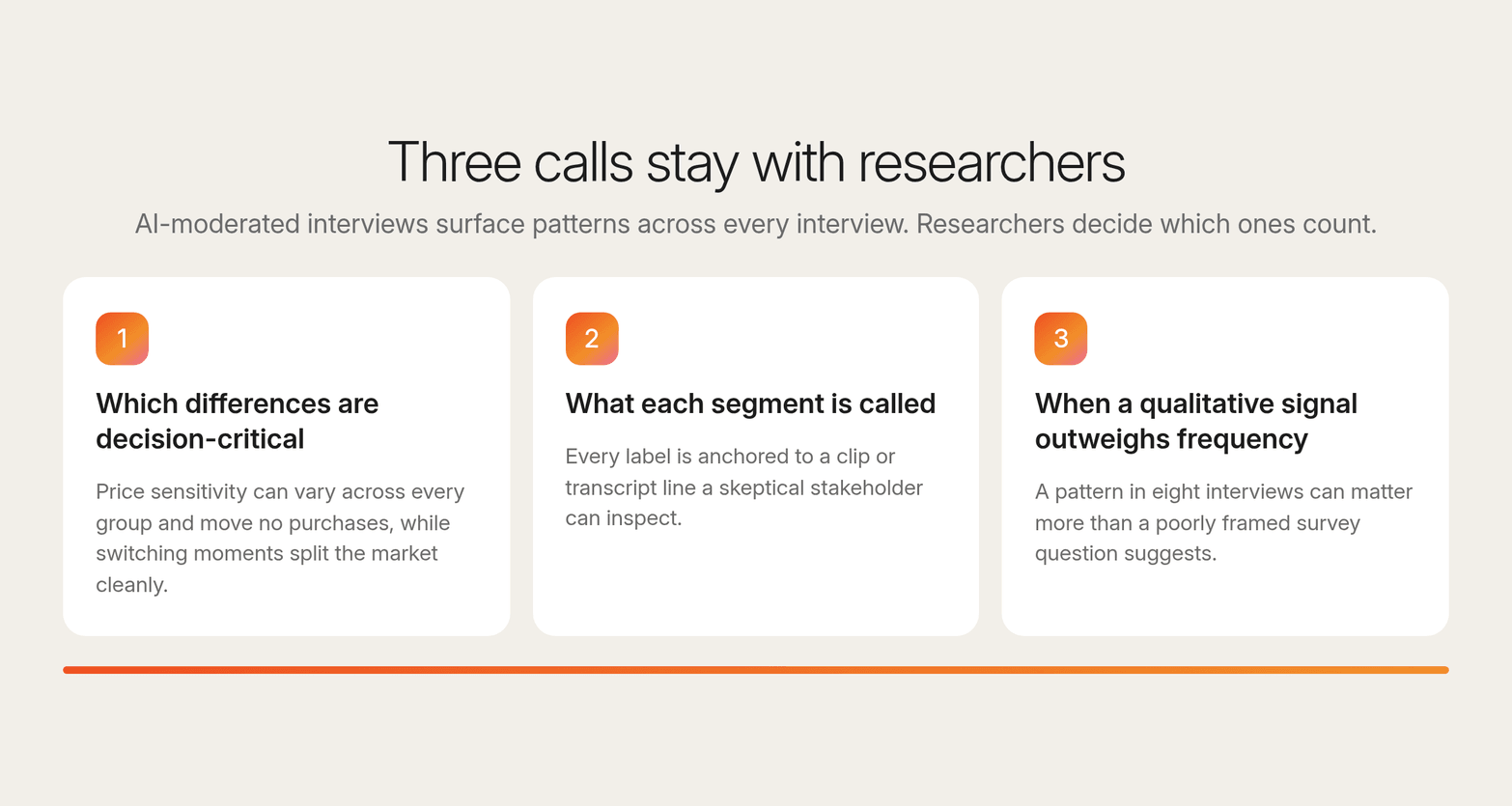
The five-step framework narrows guesswork, but no stage of the research decides on its own what a segment means. AI-moderated interviews can surface patterns across every interview in the study and help identify segments worth testing, but researchers still decide, through thematic analysis, which of those patterns count. That split keeps interpretation with the research team.
Three calls stay human:
Which differences are decision-critical. Price sensitivity may vary across every group yet move no purchases, while switching moments may split a market cleanly.
What each segment is called. Every label should be anchored to evidence a skeptical stakeholder can inspect, such as a clip or transcript line.
When a qualitative signal should outweigh frequency, and when it shouldn't.
A pattern in eight interviews can matter more than a survey suggests if the survey question was framed poorly. That judgment is what turns raw customer feedback into valuable insights.
3 segmentation scenarios: from clusters to customer conversations
Segmentation projects tend to fail in recognizable ways in consumer research, and each failure has a conversational fix. The three scenarios below are representative composites, not client results.
Scenario 1: The persona nobody could find. A snack brand clustered survey data into five market segments and named one "Growth-Minded Gina," the kind of market research persona that never gets matched to a real shopper. A quarter later, the brand team still couldn't point to a single shopper she described. The insights lead ran in-depth interviews with 12 participants matching the cluster's profile.
All 12 participants shared one trigger: a change in household routine, such as a child starting school, that had them rethinking what they packed each week. That trigger became a competitive advantage, because marketing communication could speak to it directly and the sales team could take it into retailer conversations.
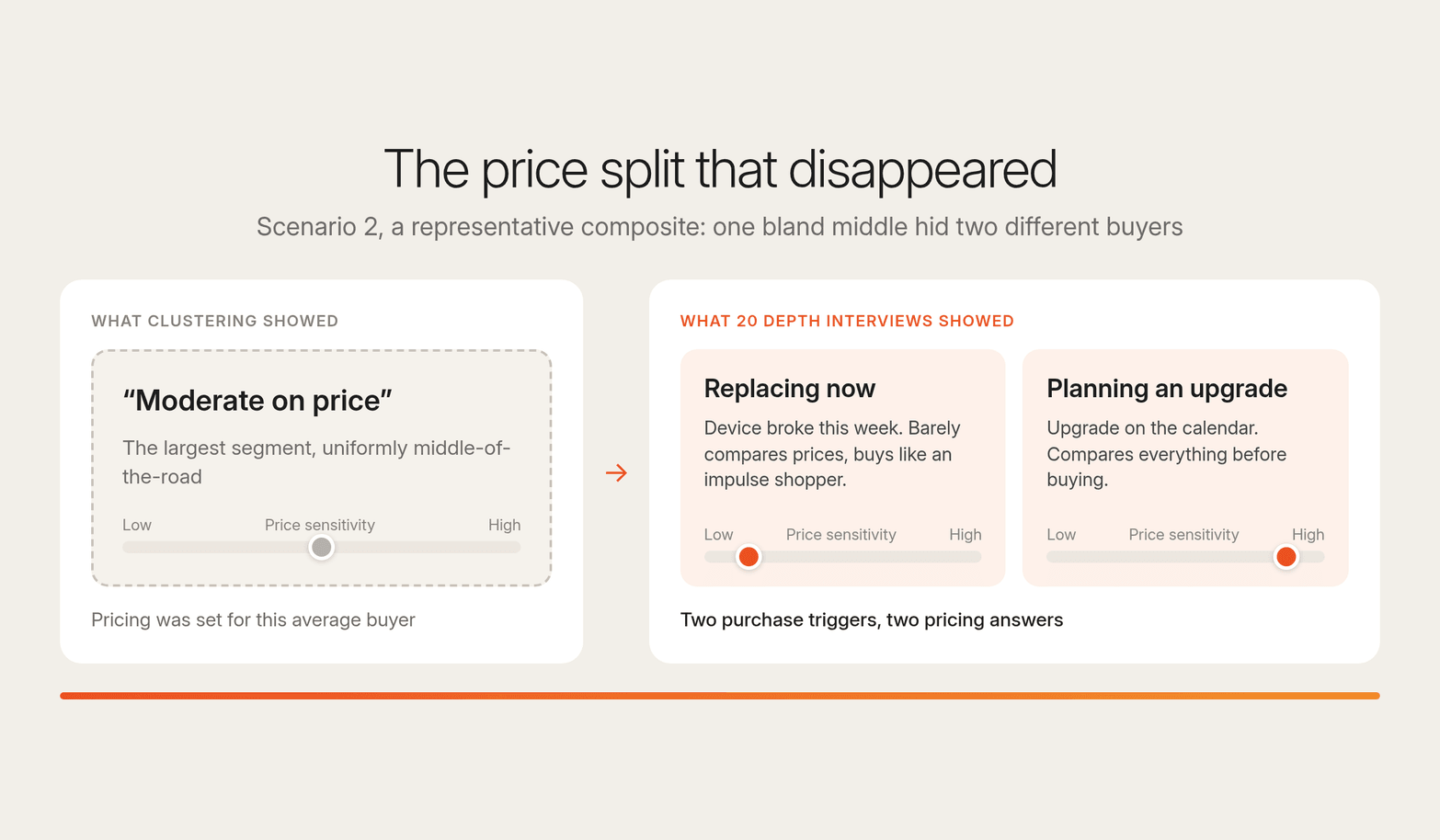
Scenario 2: The price split that disappeared. A consumer electronics brand's largest segment looked uniformly moderate on price. The team predefined two consumer segments by purchase trigger and ran 10 depth interviews in each.
One group was replacing a broken device that week and bought like impulse shoppers, barely comparing prices, while the other was planning an upgrade and compared everything. Clustering had blended two sets of purchasing habits into one bland middle, and pricing had been set for neither group.
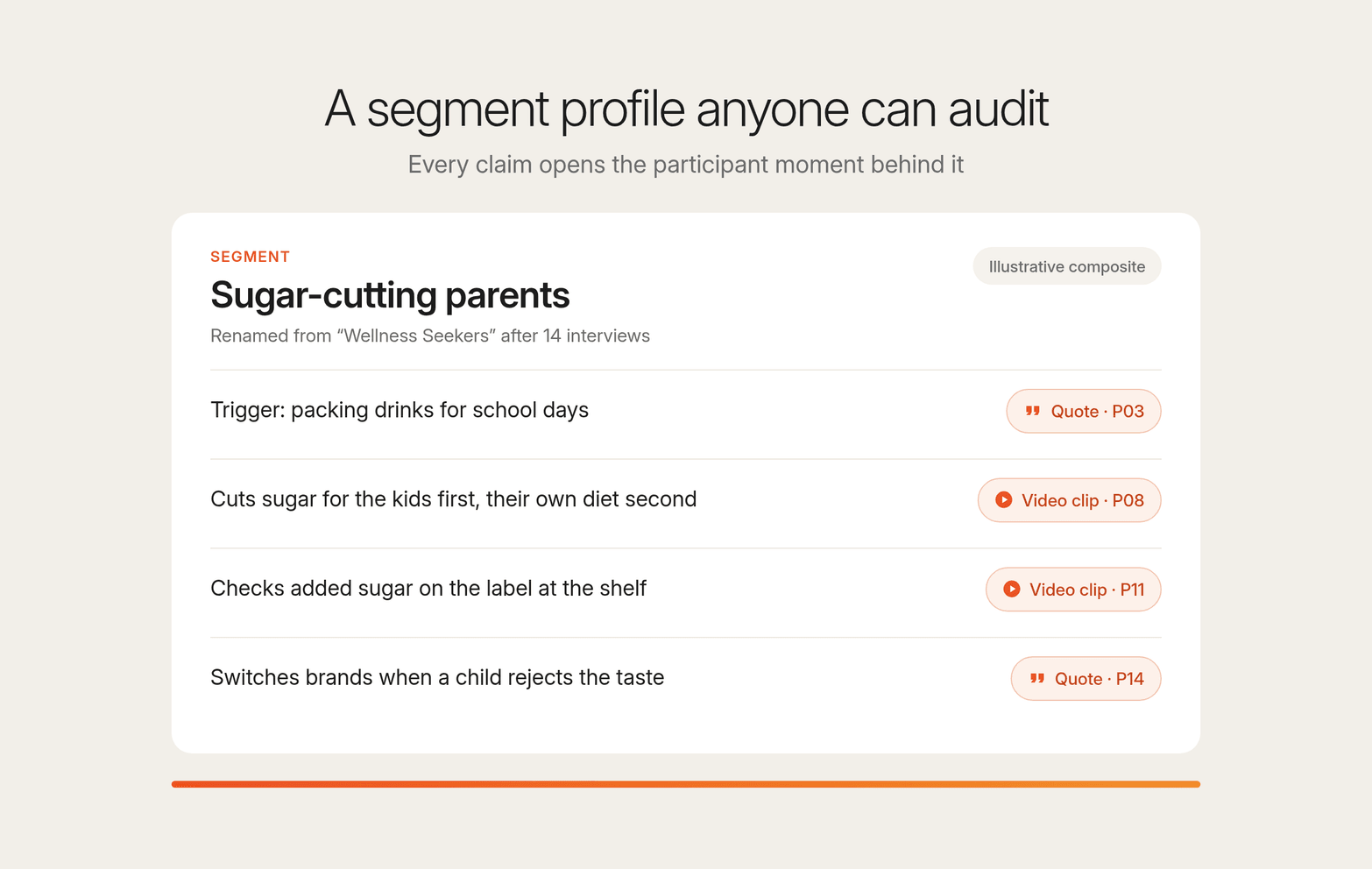
Scenario 3: The label nobody could defend. A beverage brand's workshop produced a segment called "Wellness Seekers," and the innovation lead challenged it in a portfolio review. The insights team pulled recordings and verbatim quotes from 14 interviews.
Participants talked about cutting sugar for their kids rather than themselves, so the segment was renamed and both the concept brief and the brand positioning changed. The debate ended because everyone could watch participants explain it in their own words.
3 common segmentation pitfalls that turn segments into deck decoration
Most customer segmentation research that ends up ignored fails one of three tests. Check your current market segmentation strategy against each.
1. The segment was found before it was defined. If groups came out of a cluster analysis and got names afterward, the math has likely blended buyers who differ on price or urgency. Marketing messages then target an average buyer who doesn't exist, and acquisition costs rise with every campaign aimed at them.
Fix: Define segments before recruiting anyone.
2. No label survives the question "who said that?" If a psychographic label or score can't be traced to something a participant actually said, seniority settles the next disagreement.
Fix: Tie every claim to a specific interview moment.
3. The profile is older than the market. If the last market segmentation study ran over six months ago, the segments may be shaping roadmaps and marketing activities for buyers who have moved on.
Fix: Refresh with targeted interviews and always-on consumer research between full studies, so segments stay current. That's a competitive edge when rivals are still pricing against last year's deck.
Why Conveo fits needs-based segmentation research
The gap between a statistical cluster and a shopper the brand team can recognize closes when real video conversations happen inside each predefined segment. Teams run segmentation research as an always-on layer with Conveo, so needs and language come from participants in their own words instead of a workshop.
"Conveo has definitely changed what we can pitch to clients, because it allows us to bridge the gaps between quantitative and qualitative methodologies and tell a more complete end-to-end story. It lets us close the loop: from the archetypes we've identified in the qualitative, which of them actually resonate the most? It feels more authoritative, more backed up by the data."
Fergus Navaratnam-Blair, VP Trends and Futures, National Research Group (NRG)
In a typical workflow, a team fills each segment with five to 15 participants from 8 integrated panel providers plus its own lists of current and potential customers. The team uses AI-moderated depth interviews to probe what each person says, surfacing the price sensitivity, purchase triggers, and switching moments that clustering averages away. Quantitative questions run in the same study, so the number and the reason come from the same participants.
When a stakeholder challenges a segment, each theme links to the participants behind it, with video clips and verbatim quotes stakeholders can audit. That turns segment profiles into actionable insights brand teams can use. Conveo's AI Personas (in beta) take this further, building personas from your interviews, each with a profile, linked quotes, and the participants behind it.
Recurring themes and facets are recognized across studies in a searchable insight library, so the next wave starts from what earlier ones established. Conveo is built by researchers, which is why interpretation stays with the research team rather than the platform.
For teams that want segments to stay current between foundational studies rather than going stale, Conveo StoryLines runs the ongoing, wave-based refresh that keeps segment profiles matched to consumer behavior as it shifts. For a price split like the one in Scenario 2, price testing (in research preview) can add a pricing read, though a pricing curve needs a larger sample than the five to 15 per segment used for interviews.
Conveo is SOC 2 Type II certified and GDPR compliant, and each refresh runs as a short wave of video conversations, so refreshed segments land while pricing and roadmap decisions are still open.
Frequently asked questions
What is market segmentation, and what are some examples?
Market segmentation is the practice of grouping customers with similar characteristics or needs, and market segmentation research is how teams find and validate those groups. Market segmentation helps teams tailor products and services and build effective marketing strategies for each group. A demographic segment, such as homeowners aged 35 to 50, captures key demographics and shows who buys, yet says little about why they choose, hesitate, or switch. A needs-based segment, such as homeowners replacing a failed appliance this week, is defined before recruitment by urgency and price sensitivity. Surveys size each group, and interviews explain it.
What are the 5 types of market segmentation?
Segmentation research studies typically use five segmentation strategies. Demographic segmentation groups customers by demographic factors such as age, household income, marital status, or company size, which firmographic segmentation extends for B2B. Geographic segmentation groups customers by geographic location, from cities to broader geographic regions. Psychographic segmentation uses values and attitudes, though commercial teams often ignore these segments because the labels are rarely backed by evidence. Behavioral segmentation uses purchase patterns, usage, and brand loyalty. Needs-based segmentation uses the problem being solved and how buyers decide, which separates different groups that look identical on paper. Needs-based segments defined before recruitment and validated in real conversations are the most actionable segments of the five.
How is needs-based segmentation different from survey-cluster segmentation?
Survey-cluster segmentation finds statistical groups first and explains them afterward, which is why the resulting labels often describe no real buyer. Needs-based segmentation sets behavioral criteria, such as purchase triggers and how buyers evaluate options, before anyone is recruited, so every segment can be checked against what participants said from the start.
How many participants do you need per segment?
Segmentation studies built this way typically recruit five to 15 people per segment. That range is usually enough to identify segments with clear recurring patterns and differences between them, while keeping the study small enough to collect data you can trace to a real conversation. For a per-segment stopping test, see [sampling methods in qualitative research](/insights/sampling-methods-in-qualitative-research).
How often should segments be refreshed?
There's no fixed cadence that fits every category, but a market segmentation study older than six months is a signal to check whether buyers or the market have moved. Categories with strong seasonal swings may also call for seasonal segmentation and a shorter cycle. Many teams run targeted interviews between full studies specifically to catch that drift before it reaches a pricing or roadmap decision.

About the author
Florian Hendrickx
Head of Growth
Florian is Conveo’s Chief Growth Officer, leading growth strategy and go-to-market execution as the company scales. He’s held growth leadership roles at companies like Deliverect, Robovision, and Aikido Security, and brings hands-on experience across marketing, sales, and product.
More by Florian →Qualitative insights at the speed of your business.
Conveo runs AI-moderated video interviews and structures everything they say.