In this article
TL;DR
Conveo is Consumer Understanding Infrastructure for running research as an always-on program.
Agency quotes hide the full market research cost until the research budget is committed. Best for: study-by-study funders.
A program framework sums participant recruitment, fieldwork, data analysis, and repeat waves into one total cost. Best for: annual planning.
Planning those stages together funds more studies on the same budget. Best for: stretched budgets.
Most answers to the cost of market research stop at the price of one study. Insights and procurement leaders need the number for the whole year. This guide covers the key factors that set the price of each study, a six-step framework for an annual budget, three budget scenarios to compare, and the commissioning mistakes that inflate spend.
Why agency quotes hide the real cost of a research program
Most enterprise teams find out what their research year costs after the commitments that decide it are already signed. Quotes get approved one research project at a time, so the annual number only resolves once the budget is spent, and nobody decides on purpose how many questions the business can afford to answer.
The same lag shows up inside the work, which is why qualitative research is time-consuming in most agency setups. Key findings arrive after the launch or budget review they were meant to inform, so the call gets made on instinct and the evidence gets read afterward. Pricing is where that lag starts, because it sets the pace of the year.
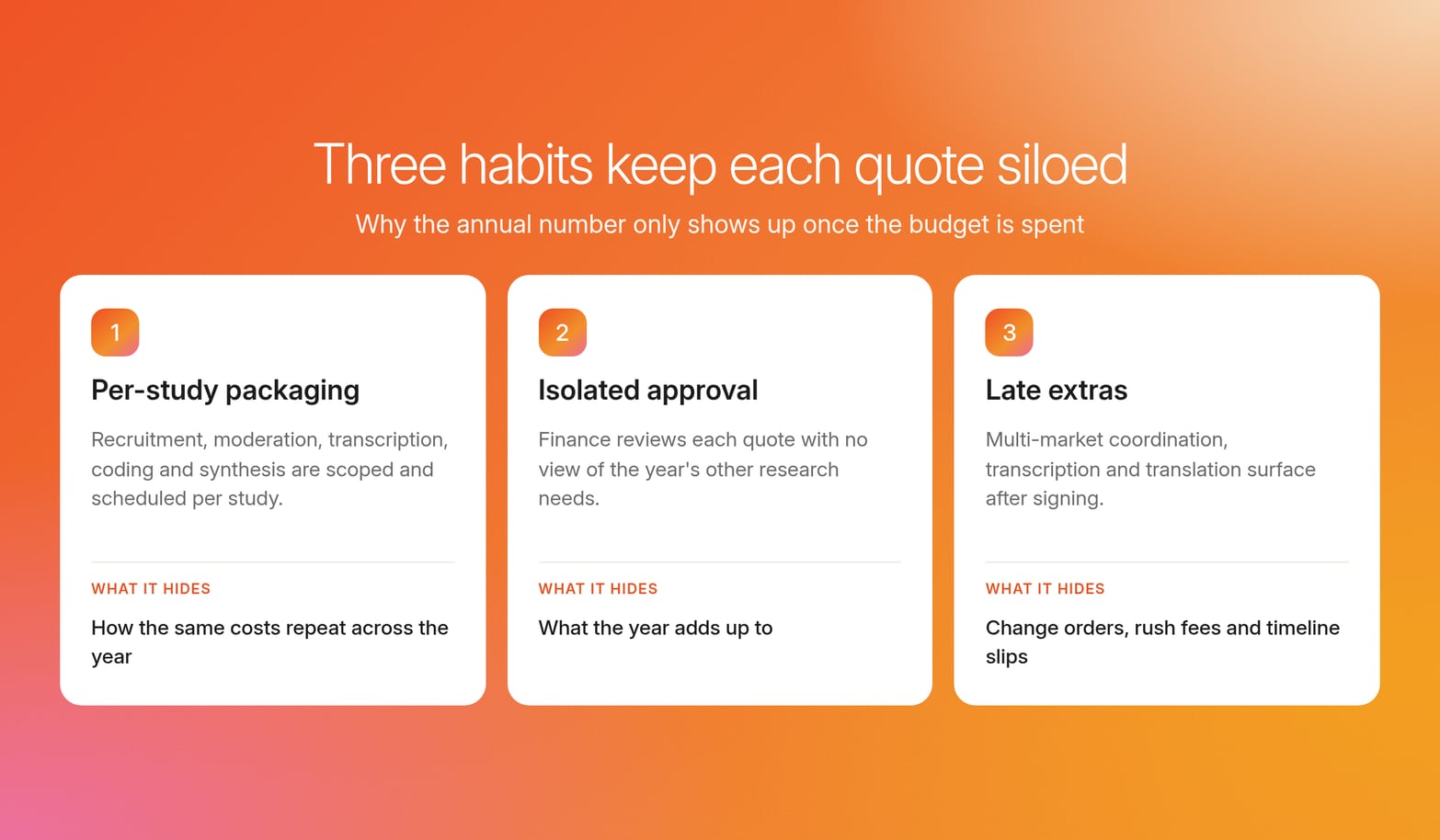
Three habits keep each quote siloed:
Per-study packaging. Participant recruitment, moderation, transcription, coding, and synthesis are scoped and scheduled per study, so each quote from a research firm arrives as a closed package.
Isolated approval. A single agency qualitative research study often runs for several weeks and can reach six-figure fees, and finance reviews that number with no view of the year's other needs.
Late extras. Some of the largest project costs, such as multi-market coordination, transcription, and translation, tend to surface after signing, as change orders, rush fees, or timeline slips.
The result is a research calendar shaped by when the money runs out. Many teams fund one or two foundational studies a year, so a persona refresh or concept question that comes up in the third quarter finds no budget left.
Conveo works as an always-on understanding layer, so evidence from real people is in hand when a decision opens.
What market research actually costs: a definition beyond the line-item quote
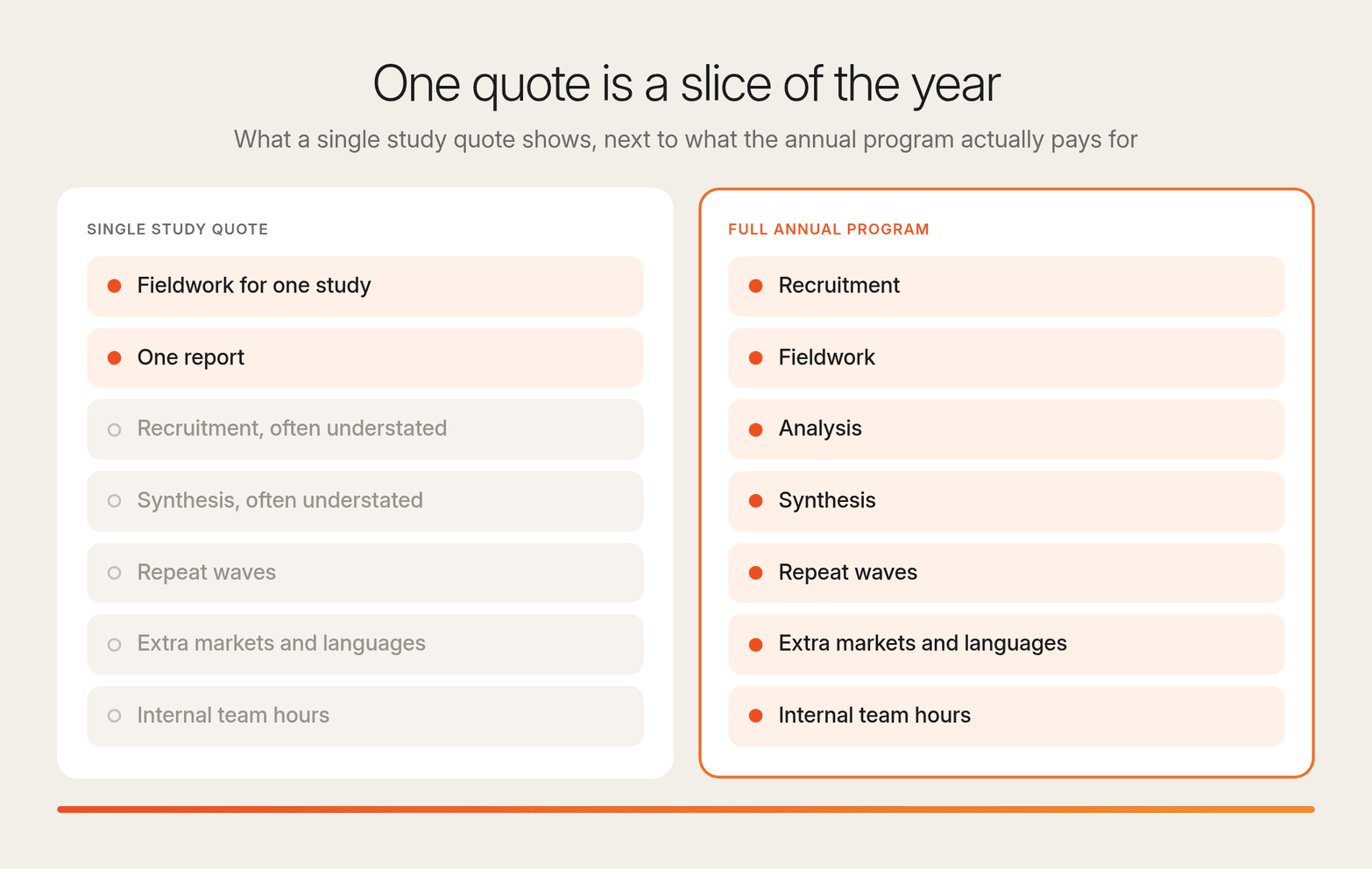
Market research cost is the full annual cost of a research program, covering every market research study, wave, and market the organization needs in a year. The number on one agency quote is a slice of it, and that quote typically leaves out or understates five components: recruitment, fieldwork, analysis, synthesis, and repeat waves.
Two components are the easiest to miss:
Repeat waves. A six-figure quote for a comprehensive study covers one wave, while an ongoing tracking program, a persona program, or a concept pipeline needs several.
Multiple markets. Cross-market agency coordination can add weeks before synthesis begins, and transcription in qualitative research and translation add time after fieldwork closes.
Within each study, a handful of key factors set the price:
| Cost driver | What pushes the price up |
|---|---|
| Research method | Primary market research, meaning data collected directly from people through in-depth interviews, focus groups, or surveys, costs more than secondary research built on existing data, which is often the most cost-effective starting point |
| Target audience | Specialized audiences such as new parents or premium pet owners cost more to reach than general consumers |
| Incidence rate | The rarer the qualifying participant, the higher the cost per completed interview |
| Project complexity | Each added market, language, segment, or stakeholder group adds coordination time |
| Analysis depth | Deeper synthesis and custom deliverables add analyst hours |
| Quantitative research | Large-scale surveys of tens of thousands of respondents buy statistical confidence, while survey design, quota management, and the choice of online surveys or phone surveys drive most of the spend in quantitative studies |
So the useful answer to "how much does market research cost?" is a program total that counts every component, wave, and market before anything is signed. The gap is structural, because a quote scoped to one study will always understate what twelve months of decisions require.
A 6-step framework for building a market research budget across the full year
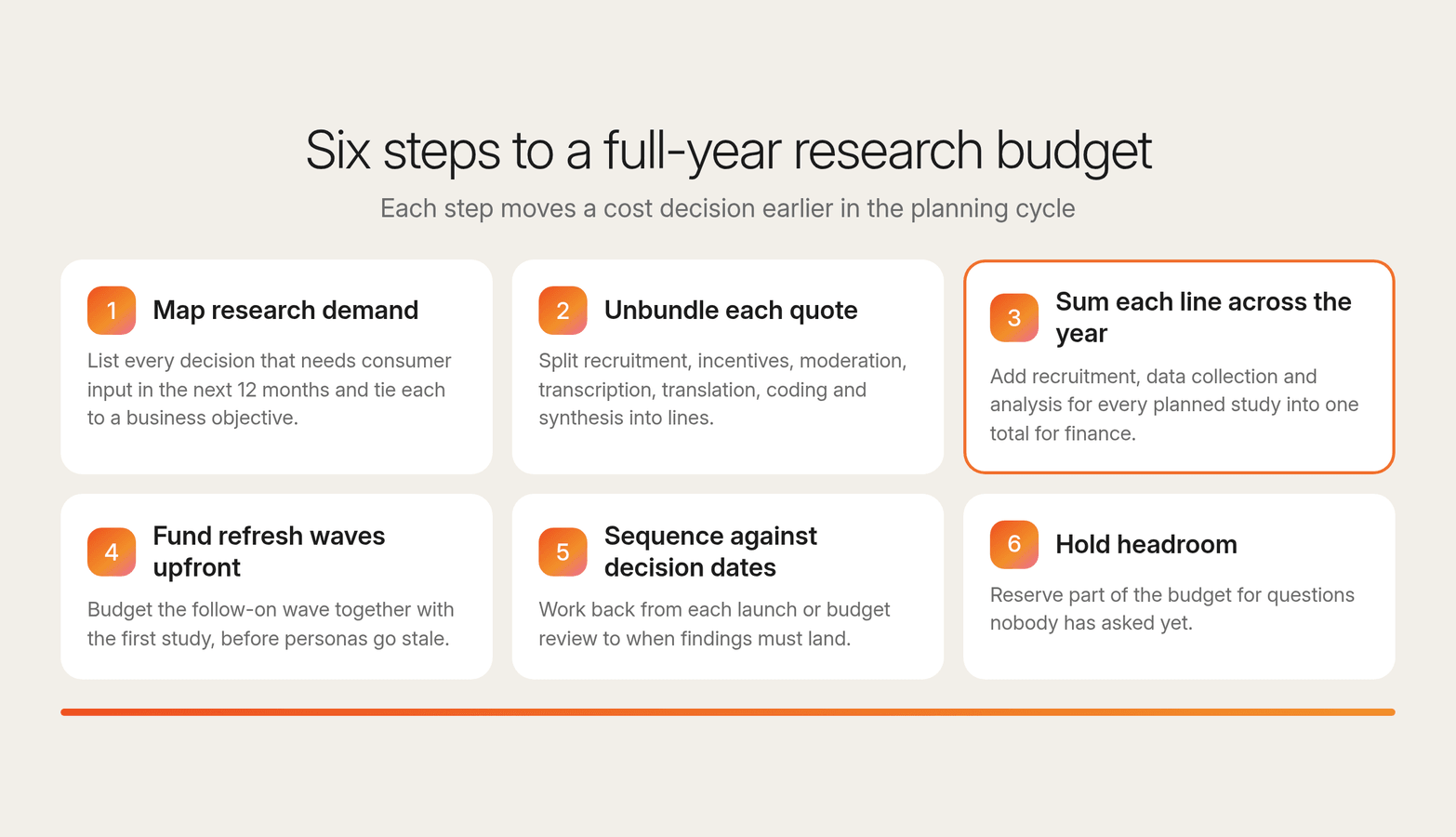
Annual budgeting starts when total market research cost becomes visible, before approving any single quote. Each step moves a cost decision earlier in the planning cycle.
Map research demand for the year. List every decision needing consumer input in the next 12 months, from launches and campaigns to pricing strategies and brand health reads. Tie each to a business objective, and mark the questions existing data sources or secondary research already answer.
Unbundle each quote. Split participant recruitment, participant incentives, moderation, transcription, translation, coding, and synthesis into separate lines. This market research cost breakdown lets you compare estimated costs across market research companies like for like.
Sum each line across the year. Add up recruitment, then data collection, then data analysis for every planned study. That total cost is what finance needs, and it usually exceeds what any one study's price suggests.
Fund refresh waves upfront. Market research personas go stale as categories shift, so budget the follow-on wave with the first study.
Sequence against decision dates. Work back from each launch or budget review to when findings must land. A study that lands after the decision has no return.
Hold headroom. Reserve part of the research budget for questions nobody has asked yet, since the most urgent requests often arrive outside the plan.
Conveo's view, built from work with 400+ enterprises, is that this annual number matters more than any single price. It sets how many questions the business can answer, and how many turn into actionable insights in time to matter.
Where researcher judgment decides the budget
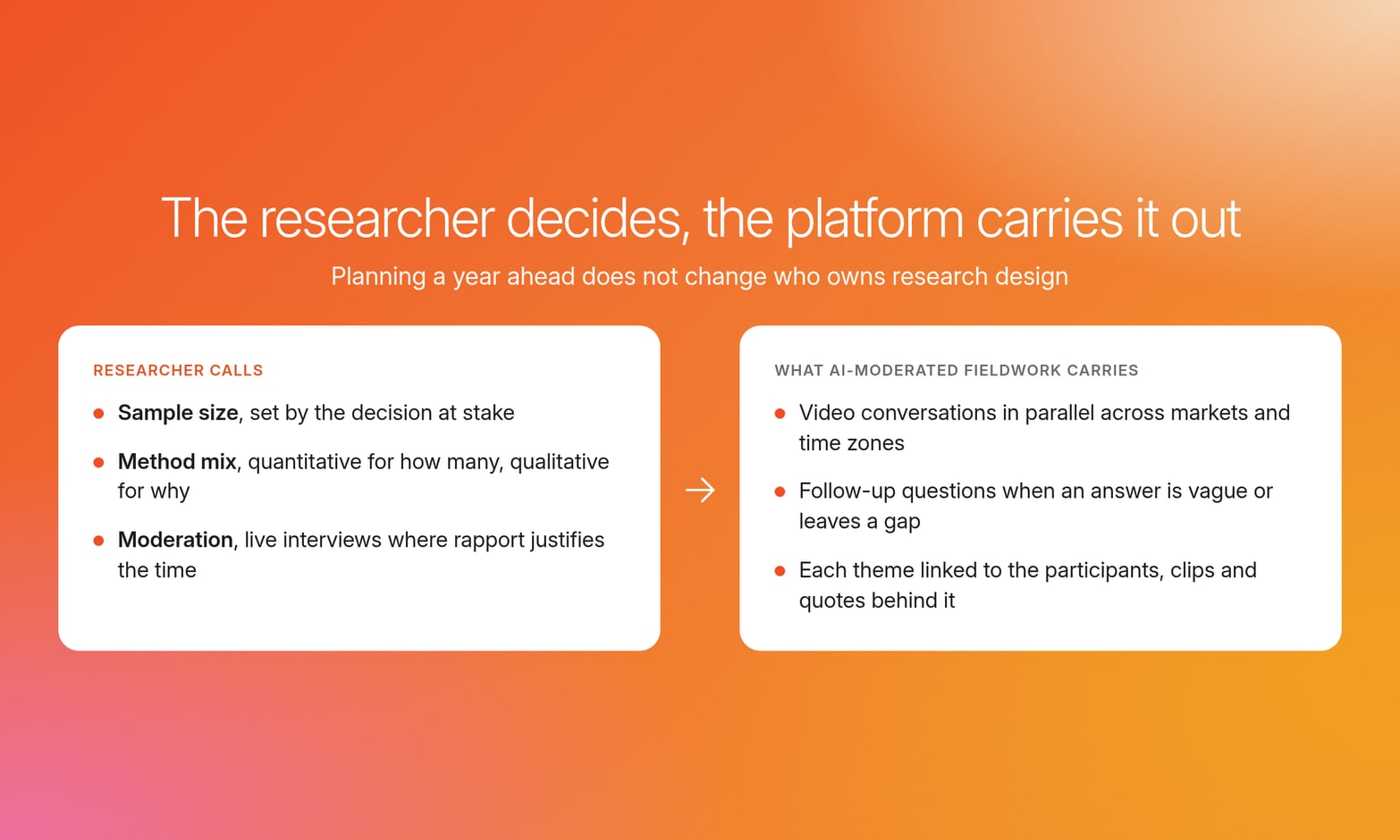
Market research cost stays tied to the right research method when the researcher decides sample size, method mix, and moderation. Planning a year ahead does not change who owns research design, and on Conveo, built by researchers, that planning authority stays with the researcher.
The calls that shape the budget:
Sample size. It follows the decision at stake and the sampling methods in qualitative research behind it. Teams generally find 5 to 15 participants per persona segment enough to identify behavioral patterns, and 8 to 12 can support an initial qualitative study.
Method mix. It depends on the research methodology: quantitative methods, such as surveys, show how many people hold a view; qualitative research explains why; and most annual programs budget for both.
Moderation. Live in-depth interviews remain the right call for sensitive topics and exploratory work where human rapport justifies the added time. Focus groups and online communities also require trained moderators, so budget that time alongside fieldwork.
AI-moderated interviews are qualitative interviews where Conveo's AI research assistant runs the conversation on video and asks follow-up questions when an answer is vague or leaves a gap. Each theme links to the participants behind it, with video clips and verbatim quotes stakeholders can audit.
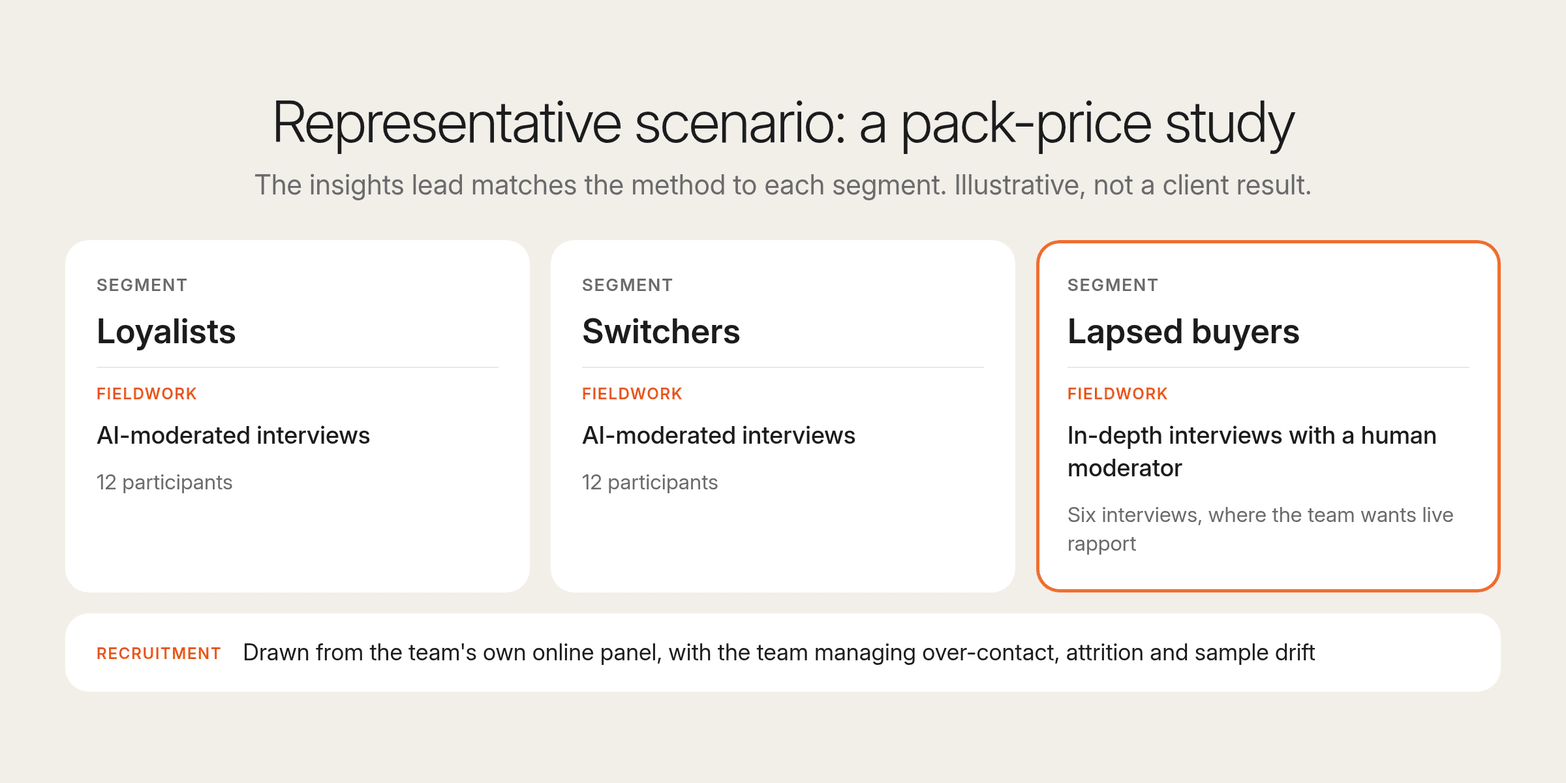
Here is how that plays out in a representative scenario rather than a client result, where an insights lead scopes a pack-price study across loyalists, switchers, and lapsed buyers:
Sample: 12 participants per segment.
Loyalists and switchers: AI-moderated interviews.
Lapsed buyers: six in-depth interviews with a human moderator, where the team wants live rapport.
Recruitment: drawn from the team's own online panel, with the team managing over-contact, attrition, and sample drift.
For budget owners, an annual plan is only as sound as the researcher judgment inside it, and high-quality results depend on research technology that carries out that judgment.
3 budget scenarios: agency quote, in-house build, and Conveo program
Each scenario produces a different market research cost once every stage and wave is counted. Most enterprise programs blend all three, so treat this as a planning exercise for deciding which work fits where.
Agency quote. Market research companies bring senior moderation, category expertise, and project management, and full-service market research services end in a full market report with data visualization and key findings. The tradeoff is a long cycle and the high cost of per-study pricing, and scheduling interviews with busy participants can take weeks on its own.
In-house build. The team collects data itself and owns every stage. Lower costs per study are possible, but the manual load makes recurring studies hard to sustain, especially across markets.
Conveo program. An insights team can take on research it could not staff before, because participant sourcing, AI-moderated interviews, and synthesis run in parallel in one place. Findings arrive while the decision is still open.
| Scenario | Recruitment | Fieldwork | Analysis | Repeat waves | Typical cycle |
|---|---|---|---|---|---|
| Agency quote | Agency-sourced, priced per study | Live moderation, scheduled per study | Agency team, full market report per study | New quote each wave | Several weeks per study |
| In-house build | Team-run, manual screening | Team moderators, few parallel sessions | Manual coding and synthesis | Limited by team hours | Varies with capacity |
| Conveo program | 8 integrated panel partners or own list, screener questions | AI-moderated video conversations in parallel across markets and time zones | Analysis starts as each video conversation closes | Planned waves, findings connect across studies | Findings arrive while the decision is still open |
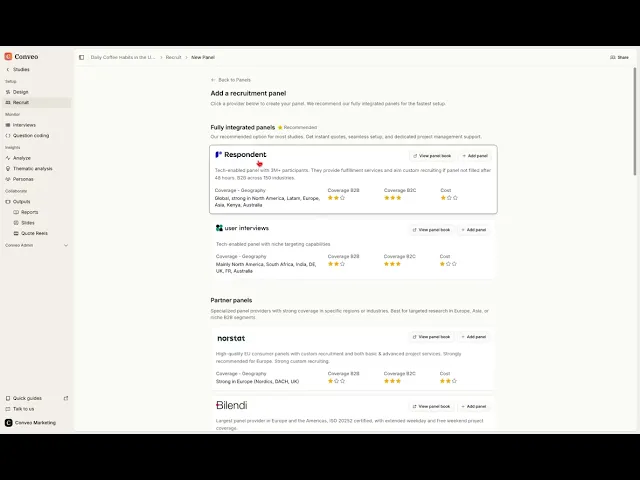
Recruitment on Conveo runs through its 8 integrated panel partners, other consumer research panels, or the team's own list. Model the three scenarios against your own markets, waves, and decision dates, including any new markets on the roadmap, before the next planning cycle opens.
Watch the walkthrough: how recruitment, screening, and launch run in one platform.
Common budgeting mistakes that inflate market research costs
Most of the spend that surprises finance comes from a few commissioning mistakes, each rooted in pricing studies one at a time.
| Mistake | What it costs | Fix |
|---|---|---|
| Approving quotes in isolation | Recruitment, fieldwork, analysis, and repeat waves stay hidden, so the total cost surfaces at year-end | Total every cost line before approving |
| Treating multi-market studies as single-market extensions | Weeks of cross-market coordination land on both the timeline and the invoice | Budget coordination as its own line, especially in new markets |
| Leaving transcription and translation out | International fieldwork adds transcription and translation time that is rarely shown in the opening quote | Add it per market |
| Counting only the agency fee | Briefings, stakeholder workshops, reviews, and debriefs consume insights team hours | Add internal hours to the annual cost |
| Commissioning late | Studies scoped after the decision window opens often carry rush fees | Sequence studies against decision dates |
Each fix changes the planning calendar, but none changes how an individual study is run.
Who this budgeting approach does not fit
Annual planning assumes repeat demand. Two situations sit outside it:
One-off studies. A team conducting market research with no repeat cadence doesn't need the annual planning effort. A single market research project can run on its own.
In-person fieldwork. In-home visits, store intercepts, and other forms of ethnography in qualitative research need a field partner.
How Conveo turns market research cost into a plannable annual program
Research spend becomes plannable when recruitment, AI-moderated fieldwork, and analysis sit in one place, so insights leaders can set one market research budget for the year in place of a stack of separate quotes, with findings arriving while each decision is still open.
What teams get in one place:
Reach. Research in 50+ languages, with 8 integrated panel partners plus your own lists, and interviews running in parallel across markets and time zones.
One plan. Recruitment, fieldwork, and analysis scoped together before anything is committed, in place of three separate quotes.
Analysis as fieldwork runs. Analysis starts as each video conversation closes, covering transcription, translation, coding, and thematic synthesis, so data analysis runs alongside data collection.
Continuity. Recurring themes and facets are recognized across studies in a searchable insight library, so the next wave starts from what earlier ones established.
Teams planning continuous research use Conveo StoryLines, the wave-based AI-moderated research program behind Continuous Consumer Understanding. Waves run on a set cadence, for example every two weeks or monthly, and each one shows the signals that moved since the last wave and why.
"I don't think it's the case anymore that doing research has to be this big investment in time and money — mainly time — this chore that slows everything down. I think it can be a resource that you can just, and should just, tap into constantly and frequently as you're making decisions."
Matt Harris, Research & Insights Lead, Canva
Enterprise insights teams at Google, AB InBev, Kellanova, General Mills, and JDE Peet's rely on Conveo to understand their consumers.
Frequently asked questions
How do I compare the full annual cost of a research platform with paying for separate agency studies?
Market research cost comparisons only work when the platform's annual cost sits against every agency study planned for the year, including repeat waves, multi-market extras, and rush fees. On Conveo, the whole study runs as one plan from sourcing to synthesis, so teams take on more research and turn more of it into actionable insights while decisions are still open.
What costs beyond the platform fee should I include for recruitment, incentives, fieldwork, analysis, and implementation?
A complete research cost model includes participant recruitment, participant incentives, fieldwork, transcription, translation, data analysis, and internal implementation time, since per-study bundling hides the annual total. On Conveo, teams recruit through 8 integrated panel partners or their own list via CSV or QR codes. Count reuse of past findings and existing data as an offset.
Can pricing cover repeat waves and continuous research programs, or does each new study cost extra?
Yes, pricing can cover repeat waves, because Conveo is built for wave-based and continuous programs. Each wave is planned inside the annual budget and builds on the searchable insight library. Each theme links to the participants behind it, with video clips and verbatim quotes stakeholders can audit, which shortens reviews. Continuous programs make market research costs predictable.
How many qualitative studies would we need to run each year for a platform investment to make financial sense?
No universal breakeven count exists, because the market research cost case depends on how many decisions need consumer input. Scope volume at 5 to 15 participants per persona segment. With interviews running in parallel across markets and time zones, teams that ran one or two studies a year can plan a full year of work and time each study to an open decision.
What pricing, usage, and renewal terms should procurement clarify before we commit to a research platform?
Procurement should clarify credit usage, repeat-wave coverage, raw data export, renewal terms, and compliance. Start with market research pricing itself: Conveo uses enterprise, credits-based pricing, so request a quote. Confirm whether follow-on waves draw from the same credits. Confirm early that the platform is SOC 2 Type II certified, ISO 27001:2022 certified, GDPR compliant, and on EU hosting (Belgium).

About the author
Alex de Hemptinne
Business Impact Lead
Alex is a Business Impact Lead at Conveo, partnering with enterprise teams to embed AI-led research into their workflows. From the first study to full-scale rollout, she helps customers shift from project-based research to continuous customer intelligence.
Meet Alex on film →Qualitative insights at the speed of your business.
Conveo runs AI-moderated video interviews and structures everything they say.