In this article
TL;DR
A brand tracking survey is a recurring questionnaire that measures brand awareness, consideration, preference, and associations wave over wave, so its value depends on staying comparable over time.
Keep the core questions identical every wave, from wording and scale anchors to panel provider and competitive set.
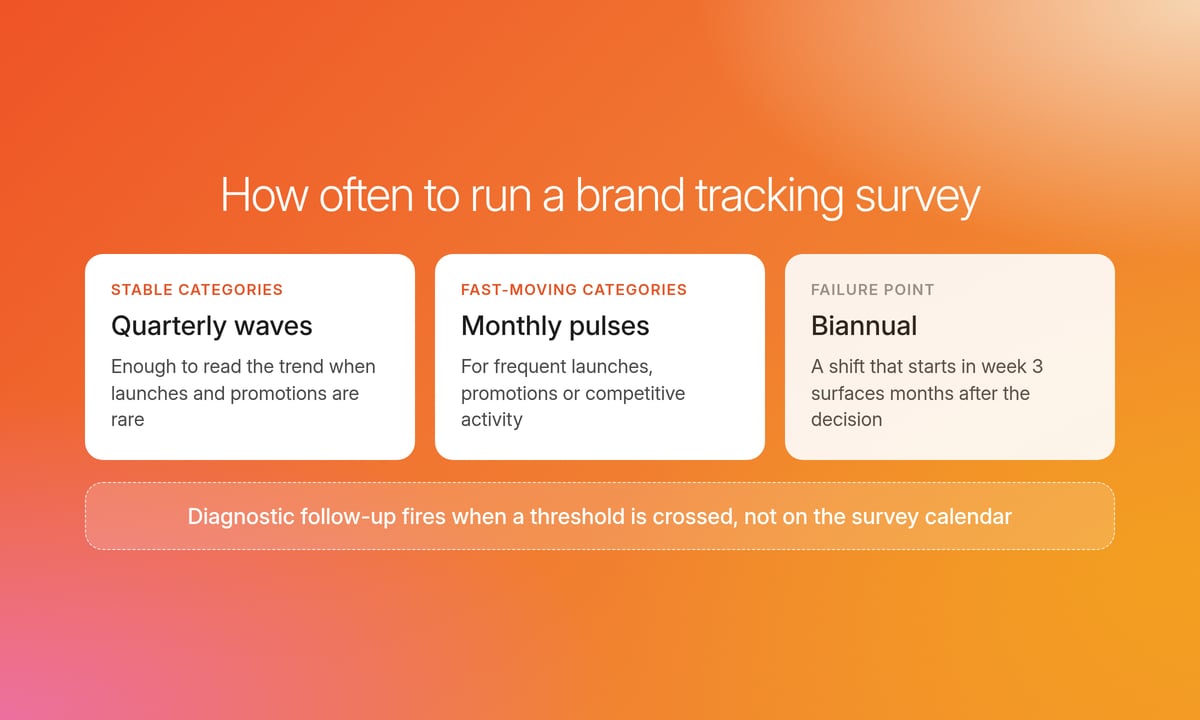
Run quarterly waves in stable categories and monthly pulses in categories with frequent launches, promotions, or competitive activity.
Route diagnosis of any movement in your brand metrics into targeted qualitative follow-up outside the questionnaire, then retire the probe.
Without that split, every wave adds a permanent question, because cutting one breaks the trend line, so fatigue rises, and data quality erodes.
The result is a brand health tracker that stays comparable over time, explains what moved and why, and stops growing every quarter.
Most brand trackers start lean and get heavier every year. A score moves, a stakeholder asks why, and the questionnaire's only answer is one more permanent question. This guide covers which questions belong in the fixed core, how often to field them, and how to explain any score shift with targeted qualitative follow-up while the trend line stays intact.
Why your brand tracker keeps getting longer and weaker
A four-point brand consideration decline lands in the quarterly deck as a finding in itself. The team debates causes it cannot test, and the advertising campaign adjustment or pricing call gets made on instinct. By the time anyone can explain the movement, the decision it should have informed has already closed.
That gap is the real cost of a brand tracking survey that measures brand health without explaining it. In Conveo's view, velocity and hit rate on new products, campaigns, and channels now decide which brands hold market share, and a quarterly score that arrives without a reason contributes to neither.
So every wave, someone asks for one more question, and nobody asks for one to come out, a common sign a team has outgrown surveys as its only instrument. Survey fatigue climbs with each addition, and data quality erodes with it.
The requests are rational. A brand tracker reports that brand awareness, trust, or consideration moved, but its fixed questions rarely explain why or what to do about it. Stakeholders patch that gap the only way the instrument allows.
Removing the question later carries a real cost. Changing wording, scale anchors, response options, panel providers, or competitive sets breaks wave-to-wave comparability. So every addition becomes permanent, and the questionnaire carries last year's debates into next year's fieldwork.
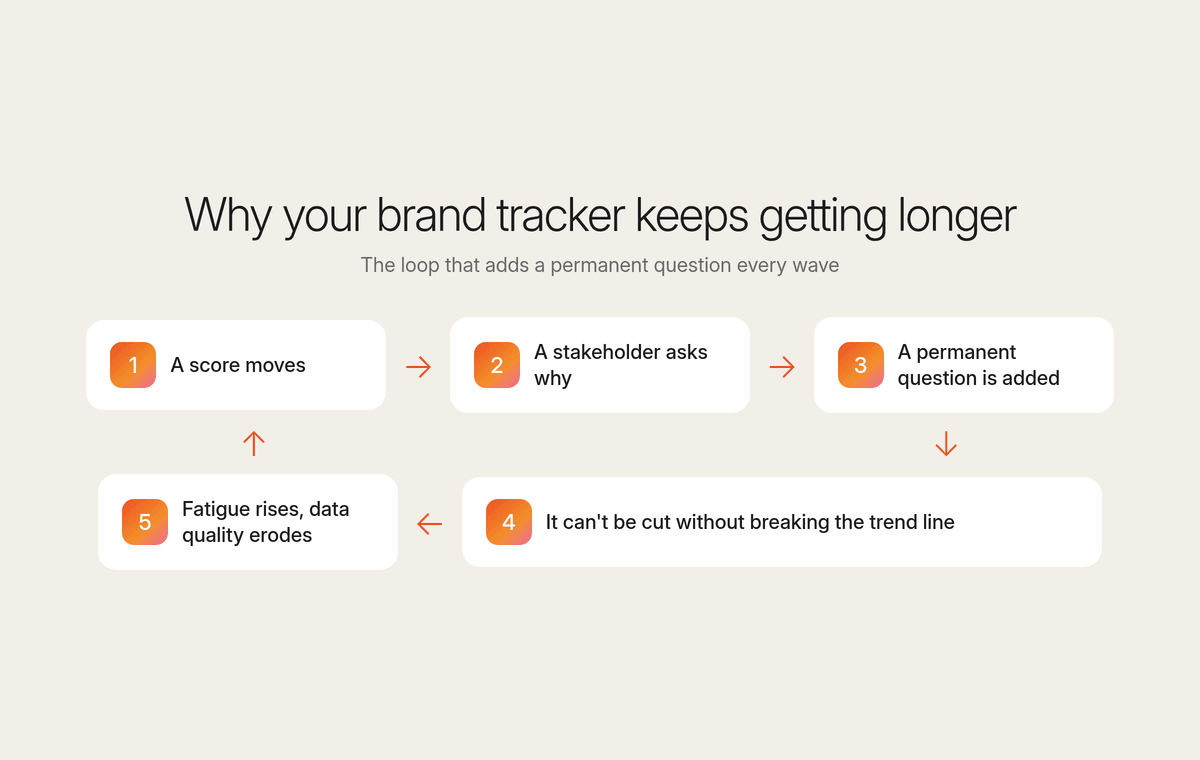
For brand managers who depend on a tracker to improve brand strategy, the question is how to explain movement without paying for it in length.
Core tracking questions vs. adaptive diagnostic follow-ups: a definition
Most bloated trackers share one root cause: two different kinds of questions living in the same instrument.
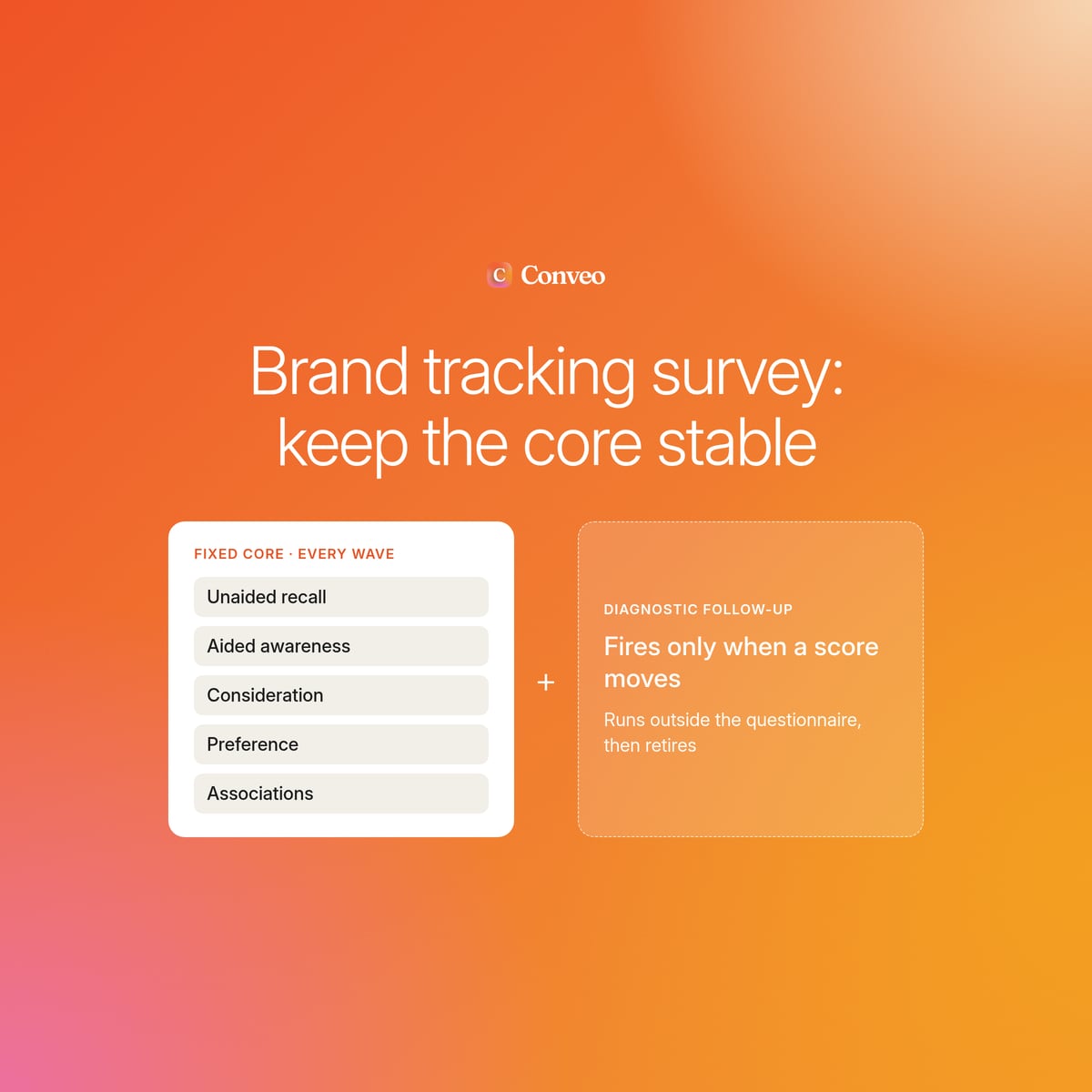
Core tracking questions are the fixed measures in a brand tracking survey, such as unaided recall and consideration, asked identically every wave so brand tracking metrics stay comparable over time. They carry the trend line and nothing else, which is why they earn their place only after careful selection.
Adaptive diagnostic follow-ups are qualitative probes added only where a score moves, run outside the brand tracking questionnaire so they never alter it. They explain one shift in brand perception and then retire.
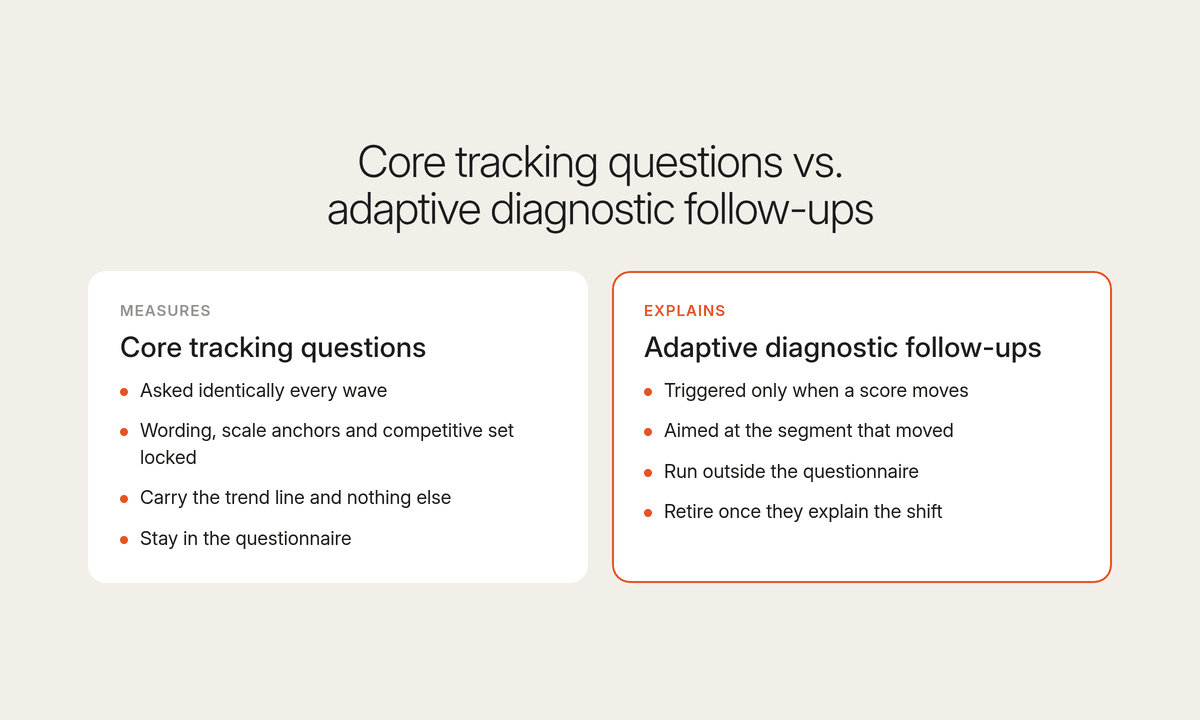
Conflating the two is why questionnaires only ever grow. Without a separate diagnostic layer, explaining a score shift requires a permanent question. Conveo's position is that the tracker should measure and a separate layer should explain, which is the pattern behind effective brand health tracking. The reason for a shift then comes from participants who match the segment that moved.
Core questions must stay identical across waves. Change any element of the instrument, and the wave-over-wave comparison starts measuring the change to the instrument instead of brand performance.
Diagnostic follow-ups run on a different logic. A measurable movement, such as a four-point consideration decline, triggers a rotating probe aimed at its cause. The decline is a prompt for investigation, and the probe never enters the core instrument.
A framework for keeping your tracker stable while it explains more
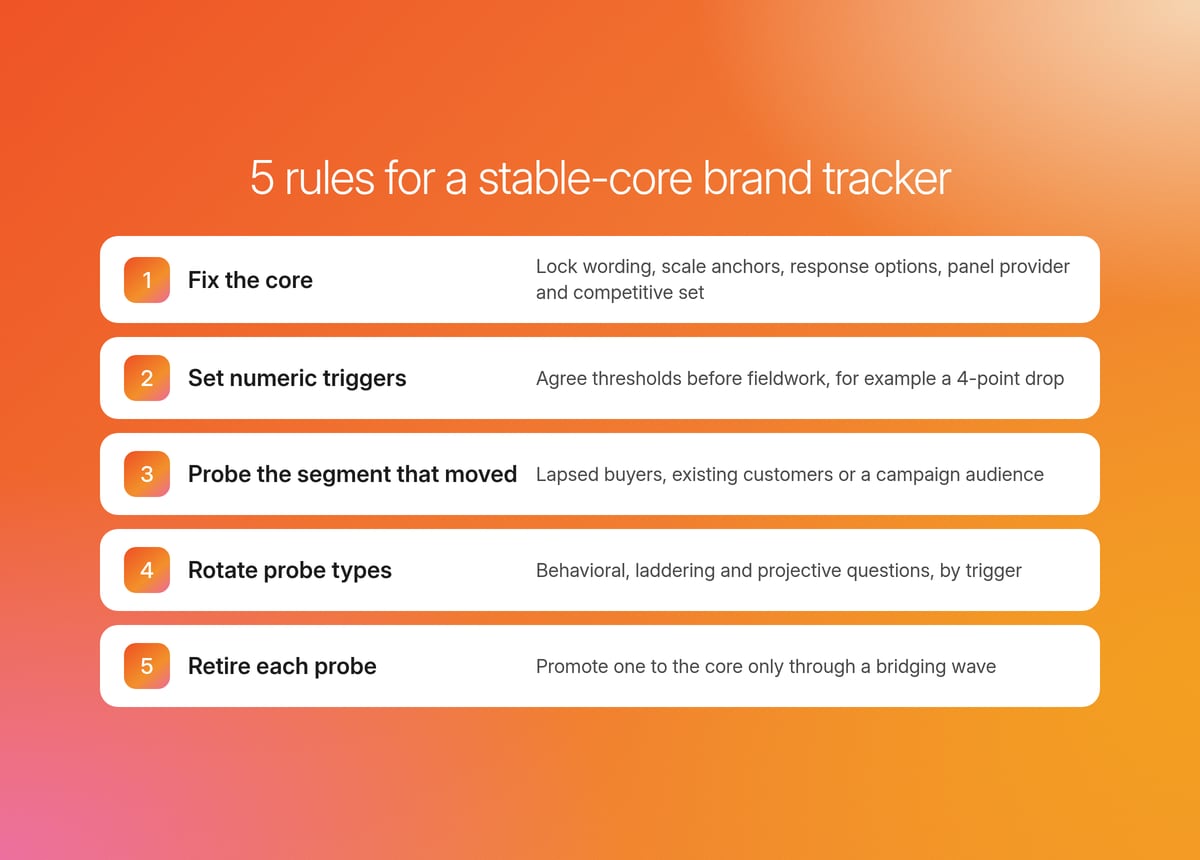
What most brand tracking survey programs lack is a trigger: a defined way to add explanation without adding permanent questions. These five rules supply it.
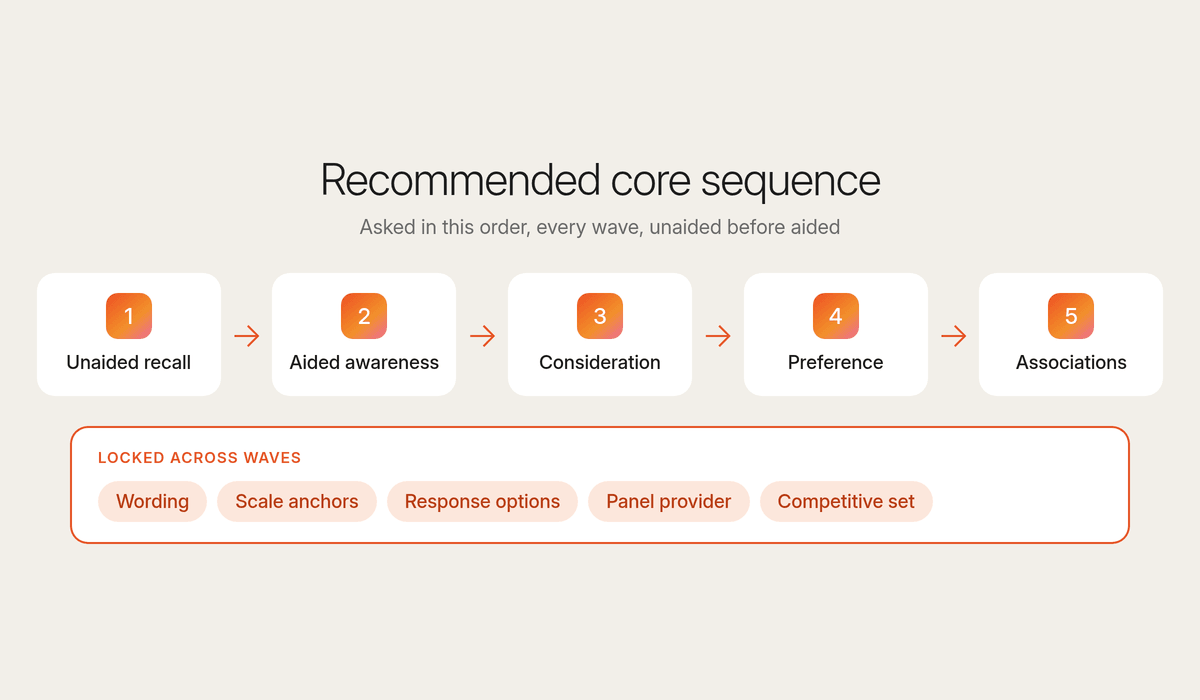
Fix the core and protect it. Choose the brand tracking questions that carry the trend line, typically unaided brand recall, aided brand awareness, consideration, brand preference, and a short set of brand associations. Many of the same items appear in standard brand equity survey questions. Many teams add brand usage questions, customer satisfaction, and net promoter score (NPS). Lock wording, scale anchors, response options, panel provider, and competitive set.
Set numeric triggers before data collection begins. Agree thresholds for each of the brand tracking metrics in advance, for example, a four-point drop on any core metric or a move outside the wave's margin of error. A crossed threshold routes to qualitative follow-up, and the deck reports the shift as open until the follow-up explains it.
Probe the segment that moved. Aim follow-up at participants who match the segment behind the shift, defined by category involvement, purchase recency, or brand relationship stage. That might be lapsed buyers, existing customers, or the target audience of a recent marketing campaign.
Rotate the probe types. Use behavioral questions about the last brand purchase or switch, laddering questions that dig into switching conditions, and projective questions. Rotate them by trigger, never into the core.
Retire each probe once it answers. If one keeps earning its place over several waves, make a deliberate case for promoting it, with a bridging wave to protect comparability.
Three operating models can run a stable-core tracker, and they carry different trade-offs.
| Operating model | How it explains a score shift | Strength | Limitation |
|---|---|---|---|
| Survey-only tracking | Adds items to the questionnaire, in-house or through brand tracking software | Keeps comparability and fields fast | Can only explain movement by adding items, which restarts the bloat |
| Separate mixed-method research | Teams conduct brand tracking studies and commission qualitative work on its own timeline | Explains shifts well when commissioned | Often lands after the decision window and starts from zero each time |
| Integrated continuous program | Pairs the fixed core with triggered follow-up in one place | Brand tracking insights connect across waves | Needs thresholds, target segments, and a follow-up owner agreed before the first wave |
Teams that want triggered follow-up running continuously alongside their fixed core use Conveo StoryLines, a continuous program of AI-moderated research that runs in recurring waves and detects signal across the wave time series rather than reporting each wave in isolation. Waves run on a set cadence, for example every two weeks or monthly, and themes carry from one wave to the next. With StoryLines V2, each wave opens on the signals that moved since the last one and the shifts that explain them, in participants' own words.
"The companies that win from here are the ones who have the greatest understanding of their consumers, and apply that understanding for the key decisions in the business."
Matt Harris, Research & Insights Lead, Canva
Where researcher judgment still decides the tracker
A fixed-core brand tracking survey does not take decisions away from the researcher. It moves them to four calls that need expertise.
Threshold. Whether a shift of a few points is signal or noise depends on sample size, seasonality, and which marketing efforts were in market that wave. A rule can flag the shift, but the researcher decides whether it earns a follow-up.
Wording. Laddering questions such as "What would it take for you to switch?" need careful phrasing. So do projective ones, such as "If this brand were a person, how would you describe them?" Framed poorly, either one steers participants toward the answer the team expects, and the study reflects the brand image the team already holds. Neutral wording is what shows how consumers perceive the brand.
Interpretation. A participant may hesitate, go flat in tone, or rate one thing and describe another. Deciding what those moments reveal about brand sentiment is research work, and the reason multimodal research adds what a rating cannot.
Segmentation. Choosing behavioral cuts over demographics alone decides whether a follow-up finds the cause in consumer behavior.
Teams using Conveo keep design and interpretation, while Conveo's AI research assistant conducts the interviews: in-depth interviews with participants who match the segment that moved, recruited through screener questions or uploaded from the team's own participant list. Conveo is designed around that division of labor.
3 brand tracking scenarios where the core stayed stable
The three scenarios below are illustrative, not client results, and each starts from a brand tracking survey core that never changes.
Scenario 1: a dip on one metric
Trigger: A snack brand's quarterly wave shows consideration down four points while awareness and trust hold steady.
Follow-up: The four-point consideration trigger fires, and the team runs qualitative follow-ups with lapsed buyers, asking behavioral questions about their last purchase.
What it explained: Participants describe a smaller pack at the same price, which they read as a hidden price rise. The brand team adjusts its pack messaging before the next wave, which fields an unchanged core, and the deck carries actionable insights with the questionnaire the same length as before.
Scenario 2: a competitor campaign
A brand health survey on a biannual cadence would miss this one entirely.
Trigger: A challenger launches a new social media campaign three weeks into the quarter, and a monthly pulse shows brand preference slipping among recent category buyers, crossing the agreed threshold.
Follow-up: Laddering probes ask what would move participants away from their preferred brand.
What it explained: Participants repeat the challenger's claim almost word for word. The creative team gets something specific to answer while the social media campaign is still running, and the core instrument never learns the challenger's slogan.
Scenario 3: a pricing change
Trigger: A subscription brand raises prices and trust dips three points overall, with brand satisfaction sliding alongside it. Demographic cuts show nothing useful.
Follow-up: The team segments results by brand relationship stage.
What it explained: The decline sits almost entirely among second-year customers, the loyal customers the brand most needs to keep. They describe feeling taken for granted after an increase that changed nothing about their customer experience except the bill. The trust score alone could not name that customer loyalty problem, and the core instrument stays untouched throughout.
In all three, the core questions stayed identical, and the explanation came from a probe that retired after one wave, the same way enterprises use consumer intelligence for brand strategy between waves.
3 common mistakes that inflate a brand tracking questionnaire
Brand tracking survey bloat starts with stakeholder requests, and three tactical errors accelerate it.
Asking aided awareness before unaided recall. Showing the brand list first primes participants, so mental availability looks stronger than it is. Fix it by sequencing brand tracker questions with unaided brand recall first, then aided brand awareness, then consideration, every wave.
Changing the instrument instead of fixing the root cause. A new panel provider, a reworded item, or a competitive set that swaps other brands in or out breaks comparability, and teams then add compensating questions to bridge the gap. Fix it by locking the core and running a parallel bridging wave for any unavoidable change.
Writing brand associations in internal language. Brand attributes such as "innovative" or "trusted" come from the brand's own messaging, so participants agree with them and reveal little. Fix it by drawing attributes from participants' own words, gathered in qualitative follow-up, the approach behind well-built brand perception survey questions.
Each fix either shortens the instrument or stops it growing, and each one protects the trend line your brand tracking strategy depends on. Conveo's view is that the third fix matters most, because an association written in participants' language is how you measure brand perception in consumers' own terms.
How Conveo keeps the trend line intact while explaining every shift
A brand tracking survey can keep its core fixed wave to wave and still explain every shift in brand performance. The condition is that follow-up interviews activate only when a score moves, so nothing gets permanently bolted on.
Teams add Conveo alongside an existing tracker, a setup covered in our guide to consumer research for enterprise teams, and hold an always-on read of where their own brand stands in the target market between waves, so nobody waits a quarter for the next score.
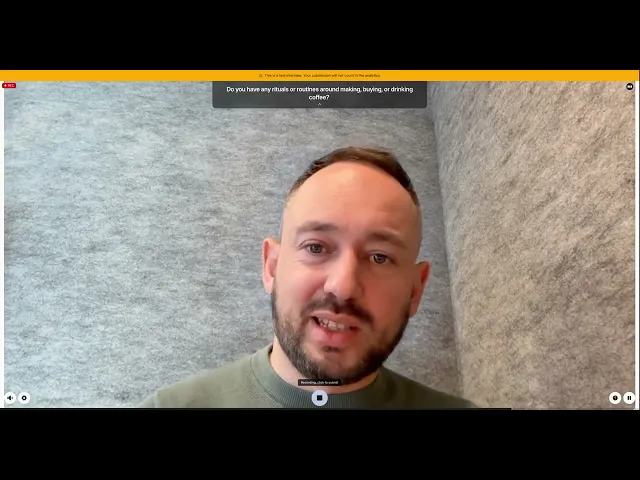
Rigor is what makes the explanation usable. Teams hear the reason behind a score because Conveo's AI research assistant asks follow-up questions when an answer is vague or leaves a gap, building on what the participant said earlier, and emotions are tagged from face, voice, and words across every session. The score and the reason can come from the same participant in the same video conversation, using quantitative questions inside the interview. Each theme links to the participants behind it, with video clips and verbatim quotes stakeholders can audit.
Findings also compound across waves. Recurring themes and facets are recognized across studies in a searchable insight library, so the next wave starts from what earlier ones established instead of a blank codebook. Last quarter's explanation stays available when a similar shift appears next year, and that accumulated understanding becomes a competitive advantage.
For procurement and European buyers, Conveo is SOC 2 Type II certified and GDPR compliant, with European hosting and primary infrastructure in Belgium. Follow-up runs alongside the tracker, which keeps the explanation inside the decision window, while the pricing or campaign call is still open.
For the budget holder, the argument is simpler than questionnaire design. A tracker that reports movement without explaining it pushes marketing strategies and pricing calls back onto instinct, and that guess is more expensive than the research.
Frequently asked questions
What should a brand tracking survey sample include?
A brand tracking survey sample should hold demographics steady wave to wave and mirror the target market. It should also support cuts by category involvement, purchase recency, and brand relationship stage. Those behavioral segments matter because score shifts often concentrate in one group, such as lapsed buyers, brand advocates, or recent switchers, and stay invisible in demographic cuts. When one segment moves, the response is focused follow-up with that segment rather than new questions for everyone. Behavioral questions about the last purchase or switch reveal actual decision criteria and purchase behavior more reliably than hypothetical purchase intent questions.
Which brand tracking survey questions should stay fixed, and which should rotate?
The fixed questions are the key brand health metrics, such as unaided brand recall, aided brand awareness, consideration, brand preference, and brand usage. They never change wording, scale anchors, response options, panel provider, or competitive set, because any change breaks comparability. Rotating diagnostic probes sit outside the core and change by trigger: behavioral questions about the last purchase, laddering questions about switching, and projective questions. Each probe retires once it explains the shift, and one that keeps earning its place joins the core only through a deliberate bridging wave.
How often should a brand tracking survey run?
Brand tracker survey cadence should match how fast the product category moves and how often brand strategy decisions get made. Quarterly waves suit stable categories, while teams following brands in categories with frequent launches, promotions, or competitive activity need monthly pulses. Biannual tracking is the common failure point, because a shift that starts in week three surfaces months after the decision it should have informed. Qualitative follow-up runs on its own rhythm: it fires when a threshold is crossed, not on the survey calendar.
What is the difference between a brand tracker and a brand health survey?
In practice, the terms overlap, and many teams use them interchangeably for any recurring brand survey. A brand tracker usually describes the ongoing instrument fielded wave after wave to monitor movement in a fixed set of brand metrics. A brand health survey more often describes a broader diagnostic read of overall brand health, closer to [brand equity research](/insights/brand-equity-research-methods-measure-brand-value), covering brand associations and competitive position at a single point in time. A brand awareness survey is narrower still, measuring recognition and recall only. The distinction that matters is function: the trend instrument stays fixed, and the diagnostic work stays flexible.
What does a brand tracking survey example look like in practice?
A representative brand tracking survey example is a quarterly beverage tracker that fields the same core every wave: unaided recall, aided awareness, consideration, preference, and brand usage. When trust drops four points among heavy category buyers while other key metrics hold, the core stays untouched. The team runs asynchronous AI-moderated video interviews with participants who match that segment, and laddering questions such as "What would it take for you to switch?" surface the motivations behind brand loyalty that a rating scale hides. Interviews run in parallel across markets and time zones, and the next wave fields the same core questionnaire.

About the author
Alex de Hemptinne
Business Impact Lead
Alex is a Business Impact Lead at Conveo, partnering with enterprise teams to embed AI-led research into their workflows. From the first study to full-scale rollout, she helps customers shift from project-based research to continuous customer intelligence.
Meet Alex on film →Qualitative insights at the speed of your business.
Conveo runs AI-moderated video interviews and structures everything they say.